

A 1970s Colonial in Manassas usually hands you the same kitchen: a boxed-in room, a doorway to the dining room, a window over the sink, and maybe 12 feet of counter if you’re lucky. The homeowners who call us rarely open with “I want it to look like a magazine.” They say the room feels closed off, the layout fights them every morning, and they’re not sure what’s actually possible without rearranging the whole house. Good kitchen design answers that question first, and the finishes come later.
This guide covers how we design kitchens for the homes that actually fill Northern Virginia: the Colonials, split-levels, and townhomes across Manassas, Prince William, and Fairfax. You’ll get the 2026 design direction backed by real renovation data, the layout and cost realities of this market, how permits work in the City of Manassas versus Prince William County, and the decisions homeowners tell us they wish they’d made differently.
Start With How You Live, Not the Finishes
Most advice tells you to pick a layout first. That’s backwards. The layout follows how you cook and gather, and that follows your real habits rather than your aspirational ones. A household where two people cook every night needs a different plan than one that orders in four nights a week and entertains on weekends.
Before we draw anything, we work through a short list with homeowners:
- Who cooks, and do two people work in the kitchen at once?
- Where does everyone actually end up: an island, a table, the family room?
- What’s broken about the current kitchen that you’d never repeat?
- How long do you plan to stay? Resale-driven and forever-home designs diverge fast.
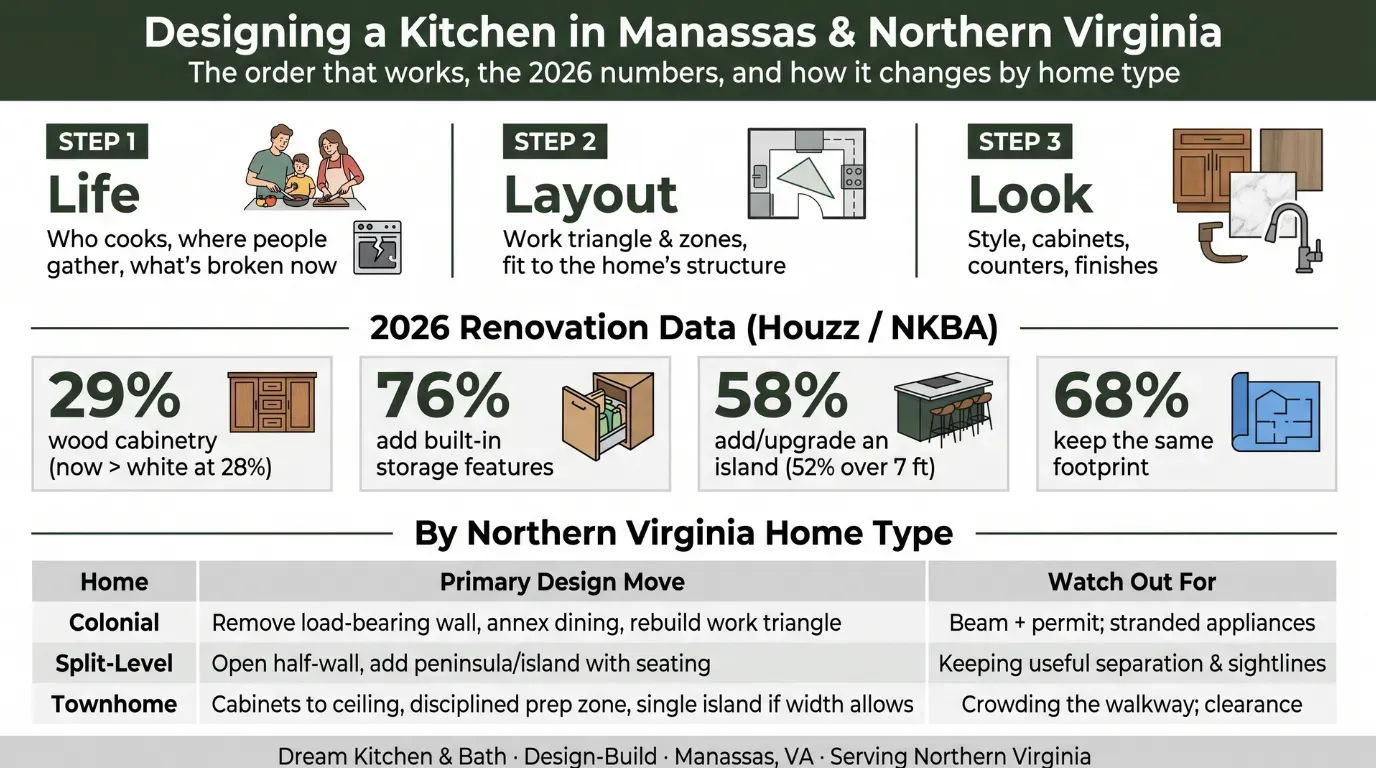
Those answers set the priorities. Layout comes next, then style and finishes. The national data backs this order: in Houzz’s 2026 study, 68% of renovated kitchens stayed roughly the same size, and the homeowners happiest a year later were the ones who fixed function before chasing a look.
|
Designing a Kitchen in Manassas & Northern Virginia
The order that works, the 2026 numbers, and how it changes by home type
|
||||||||||||
|
||||||||||||
|
2026 Renovation Data (Houzz / NKBA)
|
||||||||||||
|
By Northern Virginia Home Type
|
||||||||||||
| Dream Kitchen & Bath · Design-Build · Manassas, VA · Serving Northern Virginia |
2026 Kitchen Design Trends in Northern Virginia
The 2026 direction isn’t ultra-minimal. It’s warmer, more practical, and far more storage-driven, which suits the transitional and traditional homes common across this region.
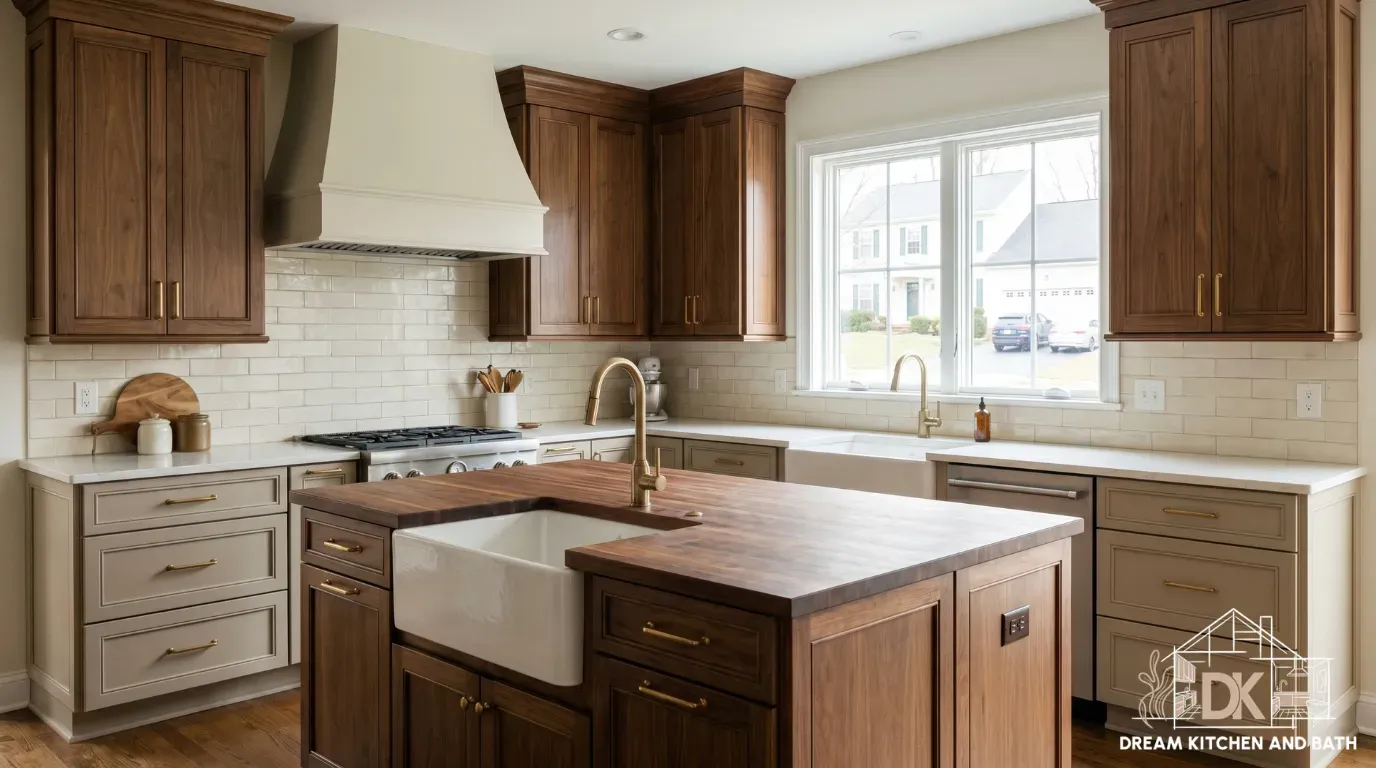
Wood has overtaken white. In Houzz’s 2026 kitchen study, wood cabinetry reached 29% of renovated kitchens, edging past white at 28%, with medium tones like white oak, walnut, and maple leading. Painted cabinets are shifting too: warm whites with creamy undertones, soft greige, and taupe are replacing the icy grays and stark bright whites of the last decade. For Northern Virginia homeowners who want a current look without a resale gamble, warm neutrals and natural wood are the safe, durable bet.
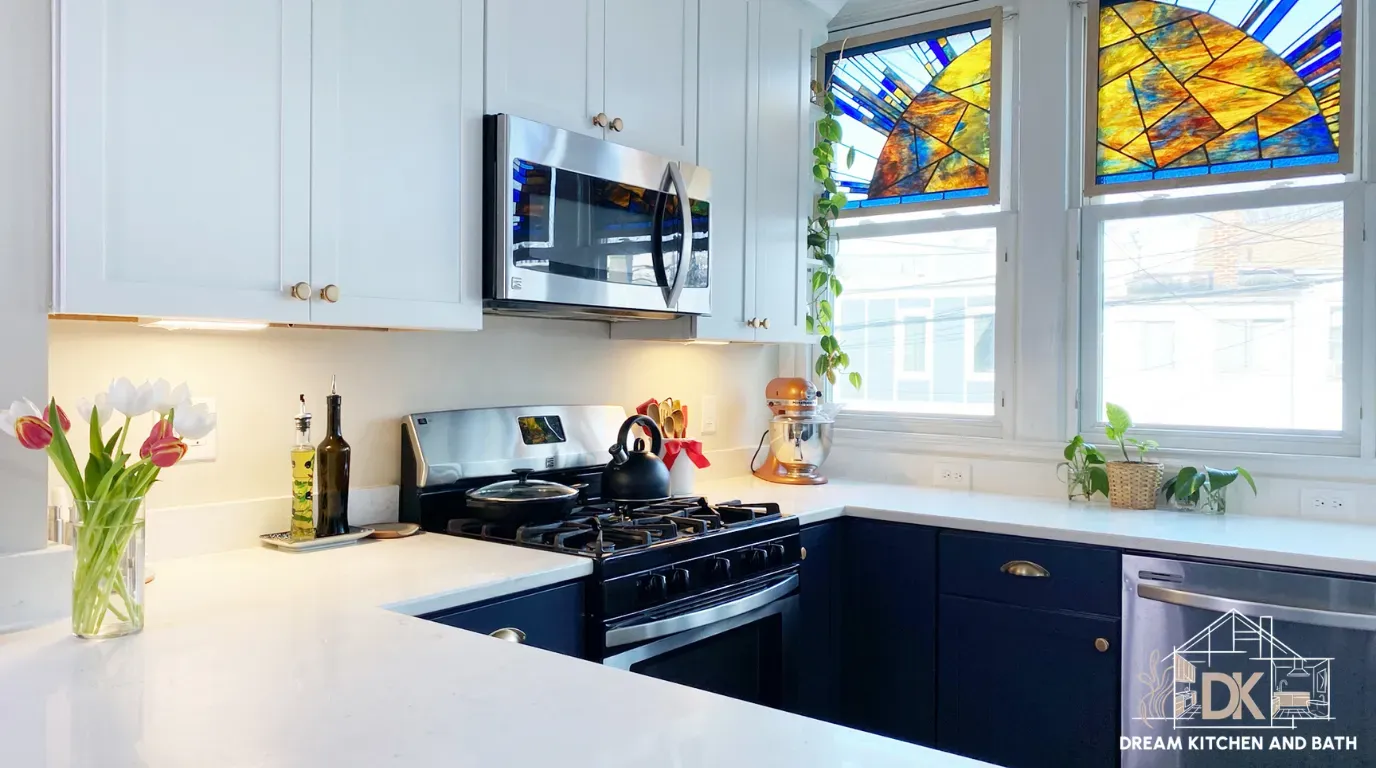
Transitional still leads the styles, sitting around a quarter of all projects, with traditional rebounding and farmhouse cooling off from its peak. Shaker doors remain the default, and the slimmer “skinny shaker” profile is popular locally for modernizing a space without clashing with an older home. On the bold end, deep greens and navy show up most often on islands or lower cabinets in a two-tone design.
Storage is now the headline, not an afterthought. Houzz found 76% of renovating homeowners add built-in features, led by pantry cabinets (47%), beverage stations (24%), and walk-in pantries (16%). The NKBA’s 2026 reporting points the same way: floor-to-ceiling cabinetry with more drawers, dedicated beverage zones, and butler’s pantries. This matters in Manassas, where expanding the footprint can trigger more cost and permitting. You can gain a lot of function by designing storage deeper and smarter before you decide to move a wall. Carrying upper cabinets to the ceiling, a long-standing fix for the dusty gap and lost vertical space, is now close to standard.
Islands keep growing. Among renovators, 58% add or update an island, and of the upgraded islands, more than half exceed seven feet and four out of five are rectangular. Over half also add an appliance to the island, usually a dishwasher or microwave. Wood has become the favorite countertop on the island specifically, often contrasting with stone perimeter counters. In smaller Manassas kitchens, though, a tight prep peninsula or a run of tall pantry storage often beats a cramped island.
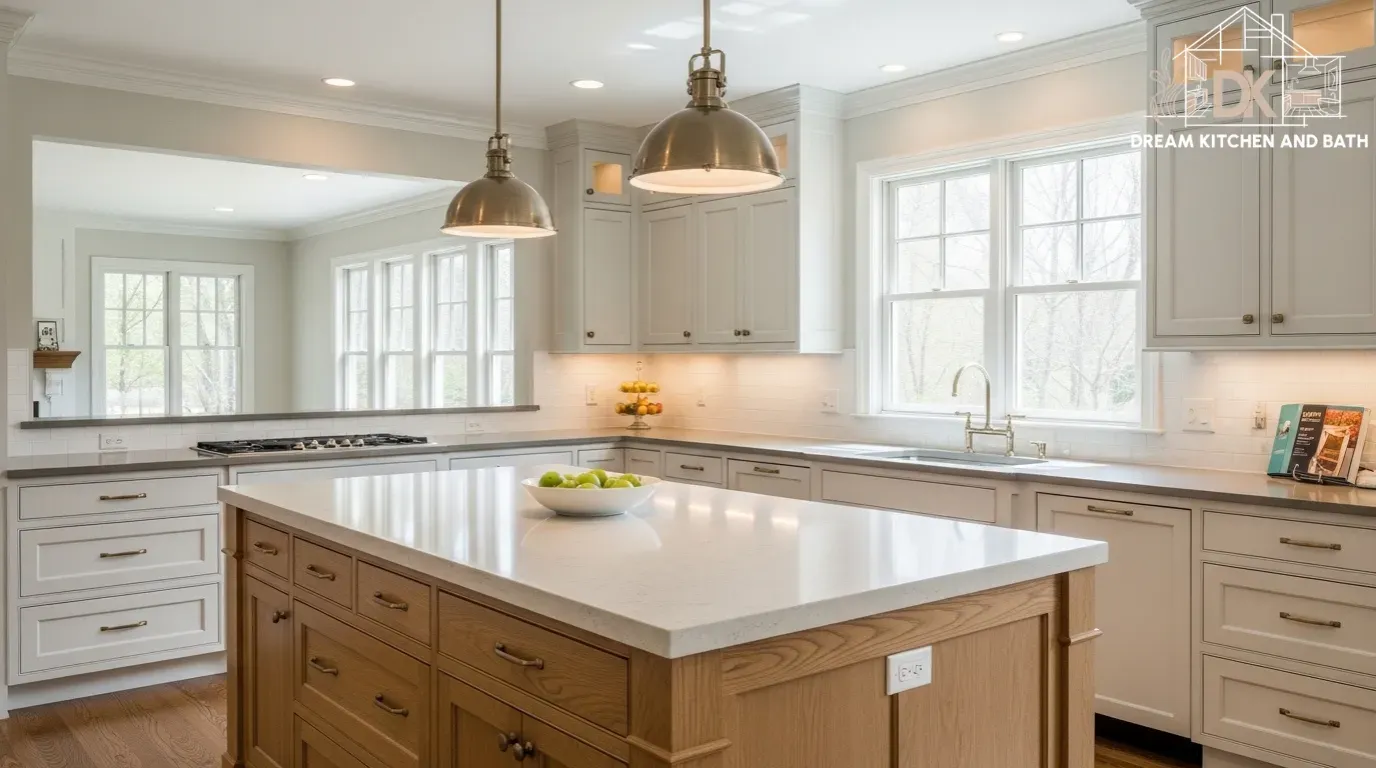
Lighting and accessibility moved up the list. Homeowners now rate natural light, quality lighting, and task lighting for work zones as top priorities, with under-cabinet lighting in the majority of projects. More than half also address accessibility during the remodel, and pull-out cabinets lead the aging-in-place upgrades. In homes still running on a single ceiling fixture and a few recessed cans, layered lighting is one of the highest-return upgrades in the whole project.
| 2026 Signal (Houzz / NKBA) | What It Means for a NoVA Kitchen |
|---|---|
| Wood 29% vs white 28% cabinetry | Warm wood & greige read current and hold resale value |
| 76% add built-ins; pantry cabinets 47% | Gain function with smart storage before moving walls |
| 58% add/upgrade island; 52% over 7 ft | Island as the workhorse in medium/large kitchens only |
| 68% keep the same size | Expand only when circulation or storage truly fails |
Designing Around Northern Virginia’s Most Common Homes
Kitchen design isn’t abstract here. The housing stock is specific, and each type comes with its own moves and traps. This is where a local design team earns its keep.
Colonials: Opening Up Without Wrecking the Work Triangle
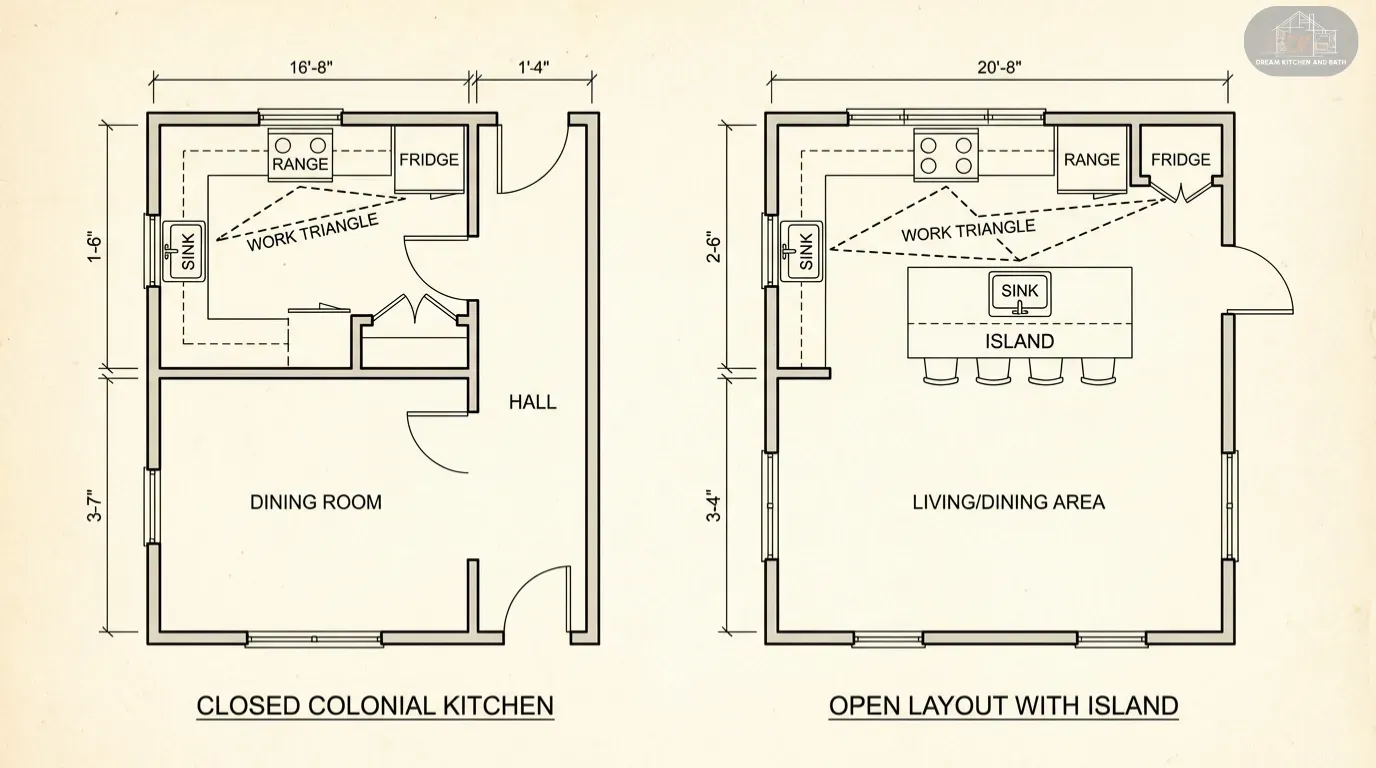
The classic NoVA Colonial kitchen sits at the back of the house, walled off from the dining and family rooms. Opening it up is the most-requested change we get. The catch: that wall is often load-bearing, and the existing work triangle of sink, range, and refrigerator was built around it. Remove it carelessly and you get a beautiful open space where the cook is stranded on a peninsula with the fridge ten feet away. The fix is to redesign the triangle and the structure together, usually by carrying a beam to replace the wall and annexing part of the formal dining room into the kitchen. Houzz data shows the dining room is exactly where most homeowners borrow space, so this is a well-worn path, not an experiment.
Split-Levels: Connecting the Kitchen to the Rest of the House
Split-levels fill Prince William and Fairfax, and their kitchens tend to feel cut off by a half-wall or a tight doorway to the living level. The goal is connection without pretending the levels don’t exist. Removing a half-wall and adding a peninsula or island with seating bridges the kitchen to the adjacent space and pulls in light, while keeping the natural separation the home’s structure gives you.
Townhomes: Galley and One-Wall Realities
Townhome kitchens trade square footage for height. You’re usually working with a galley or one-wall layout and a footprint you can’t push outward. Smart townhome design goes up and gets disciplined: cabinets to the ceiling, a tight prep zone, and a single island or peninsula only if the width genuinely allows. The win here isn’t a dramatic wall removal. It’s making every linear foot do a job.
| Home Type | Primary Design Move | Watch Out For |
|---|---|---|
| Colonial | Remove load-bearing wall, annex dining, rebuild work triangle | Structural beam + permit; stranded appliances |
| Split-Level | Open half-wall, add peninsula/island with seating | Keeping useful separation; sightlines |
| Townhome | Cabinets to ceiling, tight prep zone, single island if width allows | Overcrowding the walkway; clearance |
Choosing Your Layout
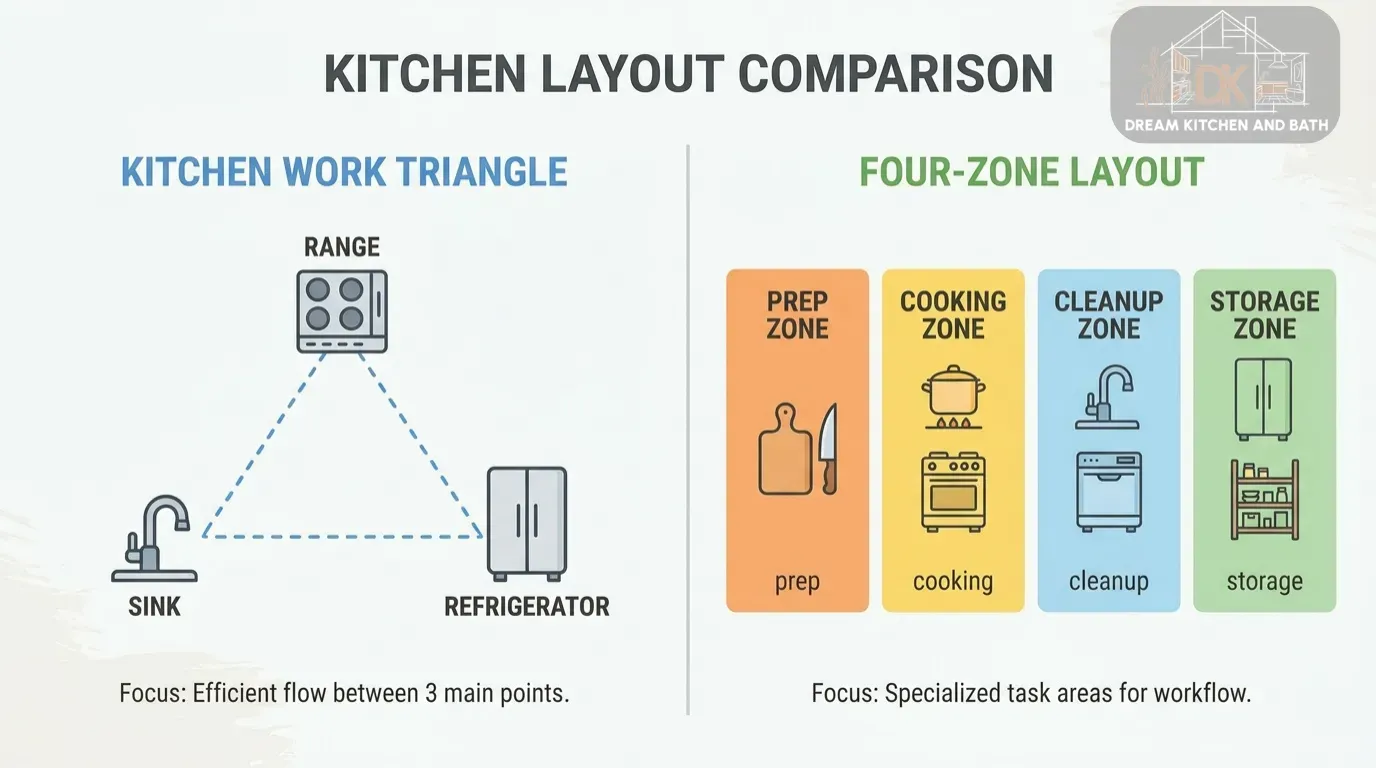
Once the home type points the way, the layout gets specific. The old rule is the work triangle: sink, range, and refrigerator positioned so you move easily between them, with no leg too long or too short. It still holds in smaller kitchens. Larger open kitchens have moved toward a zone approach, with separate prep, cooking, cleanup, and storage areas, each with its own counter and tools nearby. Most of our NoVA kitchens blend the two.
Among homeowners who changed layout in 2026, L-shaped kitchens led at 35%, U-shaped followed at 31%, and galley accounted for 14%. Here’s where each fits:
| Layout | Best Use Case | Design Note |
|---|---|---|
| L-shaped | Medium rooms open to dining/living | Frees one wall for tall storage; NoVA workhorse |
| U-shaped | Cooks who want maximum counter | Great storage if aisles stay generous |
| Galley | Narrow townhome footprints | Tall storage one side, prep/cook the other |
| Island + perimeter | Larger, entertaining-focused kitchens | Skip if clearances get tight |
| Pantry/beverage wall | Keep the footprint, add function | High impact, lower permit risk |
Clearances make or break a plan. We hold at least 42 inches of walkway around an island, 48 if two people cook, and we plan seating overhang and appliance swing before a single cabinet is ordered. For how an island fits your specific kitchen, our kitchen island guide goes deeper, and your cabinetry and countertop choices carry both the look and the budget.
What Kitchen Design Costs in Manassas and Northern Virginia?
Northern Virginia is a premium labor-and-material market, and remodeling here runs well above the national median. Part of that is local: the data-center boom in Loudoun County has pulled skilled trades into commercial work, tightening supply and pushing labor rates up for residential projects. Houzz’s 2026 study put the national median major remodel at about $55,000 and larger kitchens at $75,000; planning ranges in this region sit higher. These four bands are a realistic starting point:
| Scope | What’s Included | Typical NoVA Range |
|---|---|---|
| Cosmetic refresh | Paint/reface cabinets, new counters, backsplash, hardware, no wall moves | $15,000–$45,000 |
| Mid-range, same footprint | New cabinets, counters, flooring, appliances, lighting, modest electrical/plumbing | $45,000–$95,000 |
| Major / structural | Gut, layout change, wall opening, upgraded island, higher-end finishes | $85,000–$150,000 |
| Luxury / custom | Bespoke cabinetry, premium stone, panel-ready appliances, structural change | $150,000–$300,000+ |
As a rough allocation, cabinetry tends to take 30% of a budget, trades and installation labor around 25%, with countertops, appliances, flooring, lighting, and permits filling the rest. Build in a contingency before you choose finishes: 10–15% if the footprint stays put and the house has no known surprises, and 15–20% if it’s an older home or you’re moving plumbing, gas, or walls. That reserve is the difference between a controlled project and change-order fatigue. For the full breakdown by category and size, see our Northern Virginia kitchen remodel cost guide.
Permits, Codes, and Inspections: Manassas City vs. Prince William County
Most open-up kitchen projects in this area need a permit, and the rules share a baseline but differ in process. Virginia adopted the 2021 building codes and the 2020 National Electrical Code effective January 2024, and the grace period for choosing the older cycle ended in January 2025. So any project designed now is reviewed against the 2021 codes.
When a permit is triggered. Removing or relocating walls, especially load-bearing ones, changing the layout, or adding new electrical circuits, plumbing runs, or gas lines all require permits. Cosmetic updates like painting, refacing cabinet doors, or new flooring generally don’t, as long as they don’t touch structure or systems.
In the City of Manassas, building, electrical, mechanical, and plumbing permits are handled separately, construction plans are required for review, and the City publishes an average plan-review queue of about 1.5 weeks for residential additions and alterations. That published target gives you a real scheduling anchor.
In Prince William County, interior projects run through the County’s ePortal, and the workflow puts a zoning step first, then plan approval, permit issuance, and inspections. The County’s fee schedule is itemized by trade. Inspections must be scheduled by 3 p.m. the workday before, and residential work uses the Combination Inspection Program. Plan for a more formal administrative path and make sure your contractor knows the County’s zoning-first sequence and business-license requirement.
As a planning allowance, budget roughly $300–$800 in permit costs for a trade-only project and $1,000–$3,000+ once structural review, multiple trade permits, and gas come into play. A licensed Class A contractor typically pulls the permits, coordinates inspections, and keeps the project aligned with local requirements, which is one good reason to confirm your contractor’s license before signing.
How Long a Kitchen Project Takes?
The construction phase alone can run about four weeks once a project is fully released, but that number leaves out design, permitting, measuring, ordering, and lead-time risk, which is where schedules actually slip. A more honest planning framework, start to finish:
- Cosmetic refresh: roughly 6–10 weeks.
- Mid-range remodel, same footprint: roughly 10–16 weeks.
- Major or structural project: 16–28+ weeks, especially with custom cabinetry, slab coordination, or structural review.
Tight trade availability in this market makes early ordering and a realistic timeline more important than usual. The fastest way to blow a schedule is to start demo before selections and permits are locked.
The Design Decisions People Regret
The most useful thing a designer brings isn’t a mood board. It’s a list of the mistakes other people already made. These come up again and again on the remodels we’re called in to fix, and on what homeowners share online:
- Doors instead of drawers on lower cabinets. The number-one functional regret. Deep base cabinets with doors swallow pots in a black hole; drawers and pull-outs put everything in reach. On a tight budget, adding pull-outs to existing cabinets is the cheapest high-impact upgrade.
- Too few outlets, and bad circuit planning. Plan more than you think you need, and never put a high-draw appliance on the lighting circuit. Island outlets get forgotten until it’s too late to add them cleanly.
- A divided sink where a single deep basin would serve better. Most homeowners who switch to one large workstation sink don’t look back; it fits sheet pans and stockpots the split sink never could.
- A deep corner pantry that becomes a cave. Things vanish at the back. Pull-out shelving or a well-planned cabinet pantry beats a deep reach-in.
- Designing the layout around the wrong appliance. If you’re committed to a 36-inch range or a counter-depth refrigerator, the layout has to account for it from the start. Our appliance guide covers how to choose before the cabinets are drawn.
Beyond the kitchen itself, the regrets that sting most are about the project, not the product:
- Budget shock. NoVA pricing runs well above national averages, and homeowners who anchor to a national figure get blindsided. Set the budget against local ranges and hold a contingency.
- Timeline blowout. With trades competing for data-center and commercial work, lead times stretch. Build slack into the schedule.
- Communication breakdown. The most common complaint on review sites isn’t workmanship, it’s going dark mid-project. Agree on who updates you and how often, up front.
- Licensing confusion. Virginia requires a Class A contractor’s license for projects of this size. Verify it, and be wary of unlicensed subs.
- Material bait-and-switch. Get the specific cabinet line, countertop slab, and appliance models in writing so the quote matches what gets installed.
How Our Design Process Works?
A design-build process keeps the people drawing the kitchen and the people building it on one team, which closes the gap where a pretty plan meets a wall that can’t actually move. Ours runs in four stages:
- Consultation: we talk through how you live, your priorities, and a realistic budget range.
- Measure and assess: field measurements, plus what’s structural, where plumbing and electrical run, and what the home will allow.
- Design and selections: layout options first, then cabinets, counters, and finishes chosen against the plan and the budget.
- Permitting and build: for anything structural, we handle the drawings, submissions, and inspections through Manassas or Prince William County.
One forward-looking tip: even on a mostly cosmetic project, ask during design whether to pre-wire for induction, a future panel upgrade, better exhaust, and under-cabinet lighting now rather than reopening walls later. On incentives, note that the federal energy-efficient home improvement credits ended for property placed in service after December 31, 2025, though an EV-charger credit remains through mid-2026 and Dominion Energy offers a rebate on qualifying heat-pump water heaters. Worth a quick check if energy upgrades are on your list.
Frequently Asked Questions for Kitchen Design in Manassas & Northern Virginia
How do I design a kitchen layout for a Colonial or split-level?
Start with the structure. In a Colonial, the wall you want to remove is often load-bearing, so the new layout and a replacement beam get designed together, usually by relocating the range and annexing part of the dining room to rebuild the work triangle. In a split-level, the move is opening a half-wall and adding a peninsula or island that connects the kitchen to the living level without erasing the home’s natural separation.
What kitchen design style is most popular in Northern Virginia right now?
Transitional leads, with shaker-style doors, clean lines, and warm neutral palettes. As of 2026, wood cabinetry has edged past white nationally, and warm tones, greige, and two-tone kitchens (a stained island against painted perimeter cabinets) are increasingly the default over the all-white look.
How much does a kitchen remodel cost in Manassas?
Plan in bands: roughly $15,000–$45,000 for a cosmetic refresh, $45,000–$95,000 for a mid-range remodel in the same footprint, $85,000–$150,000 for a major or structural project, and $150,000+ for luxury custom work. Northern Virginia runs above national medians, partly because of tight trade availability, so hold a 10–20% contingency.
Do I need a permit to open up my kitchen in Manassas or Prince William County?
If you’re removing a load-bearing wall or doing significant electrical, plumbing, or gas work, yes. Manassas City reviews residential alterations in about 1.5 weeks on average; Prince William County runs interior projects through its ePortal with a zoning step first. Cosmetic updates that don’t touch structure or systems generally don’t need a permit. A design-build team handles the drawings and submissions.
How long does a kitchen remodel take?
Start to finish, plan on about 6–10 weeks for a cosmetic refresh, 10–16 weeks for a mid-range remodel, and 16–28+ weeks for a structural or custom project. The on-site construction can be as short as four weeks, but design, permitting, and material lead times add the rest.
Should I hire a kitchen designer or a design-build remodeler?
A standalone designer produces the plan; you then find someone to build it, and the two don’t always line up. A design-build firm keeps design and construction on one team, so the plan is grounded in what the home structurally allows from day one. For projects that move walls, which most NoVA open-up remodels do, that integration prevents expensive surprises.
Where do I start when designing a kitchen?
With how you live, not with finishes. Work out who cooks, where people gather, and what’s broken about the current kitchen. Those answers drive the layout, and the layout drives the style. Starting with the backsplash is how you end up with a beautiful kitchen that fights you every morning.
Designing Your Northern Virginia Kitchen
The best kitchen design for your home is the one built around how you actually live, fitted to what your Colonial, split-level, or townhome will allow, and finished in a style you’ll still like in ten years. Get the order right, life then layout then look, and the rest follows.
Planning a kitchen remodel in Manassas or anywhere in Northern Virginia? Our design team works on these exact homes every week. Schedule a complimentary design consultation to talk through your project, or see our recent Northern Virginia kitchens for a sense of what’s possible.