

A typical Manassas kitchen has 40 to 55 square feet of countertop. Replace it in builder-grade laminate and you’re looking at roughly $1,500. Replace it in honed quartzite with a waterfall island, and the same footprint can run past $9,000 installed. Same counters, same kitchen, a six-fold spread. The number that lands in the middle depends less on which material is “best” and more on how you actually cook, clean, and live in the room.
That’s the part most countertop guides skip. They rank materials as if there were a single winner. There isn’t. The right kitchen countertops for a family that sears steaks four nights a week are the wrong ones for a baker who wants a cool marble slab for pastry, and both differ from what makes sense in a rental you’ll sell in three years. We’ve designed and built kitchens across Northern Virginia for more than 20 years, and the homeowners who end up happiest are the ones who matched the surface to their habits before they fell in love with a slab.
So this guide walks the decision the way we walk it with clients in our Manassas showroom: start with how you live, then weigh durability, maintenance, look, and cost. Here’s how each major material stacks up in 2026, what it really costs in Northern Virginia, and the mistakes that cost people the most.
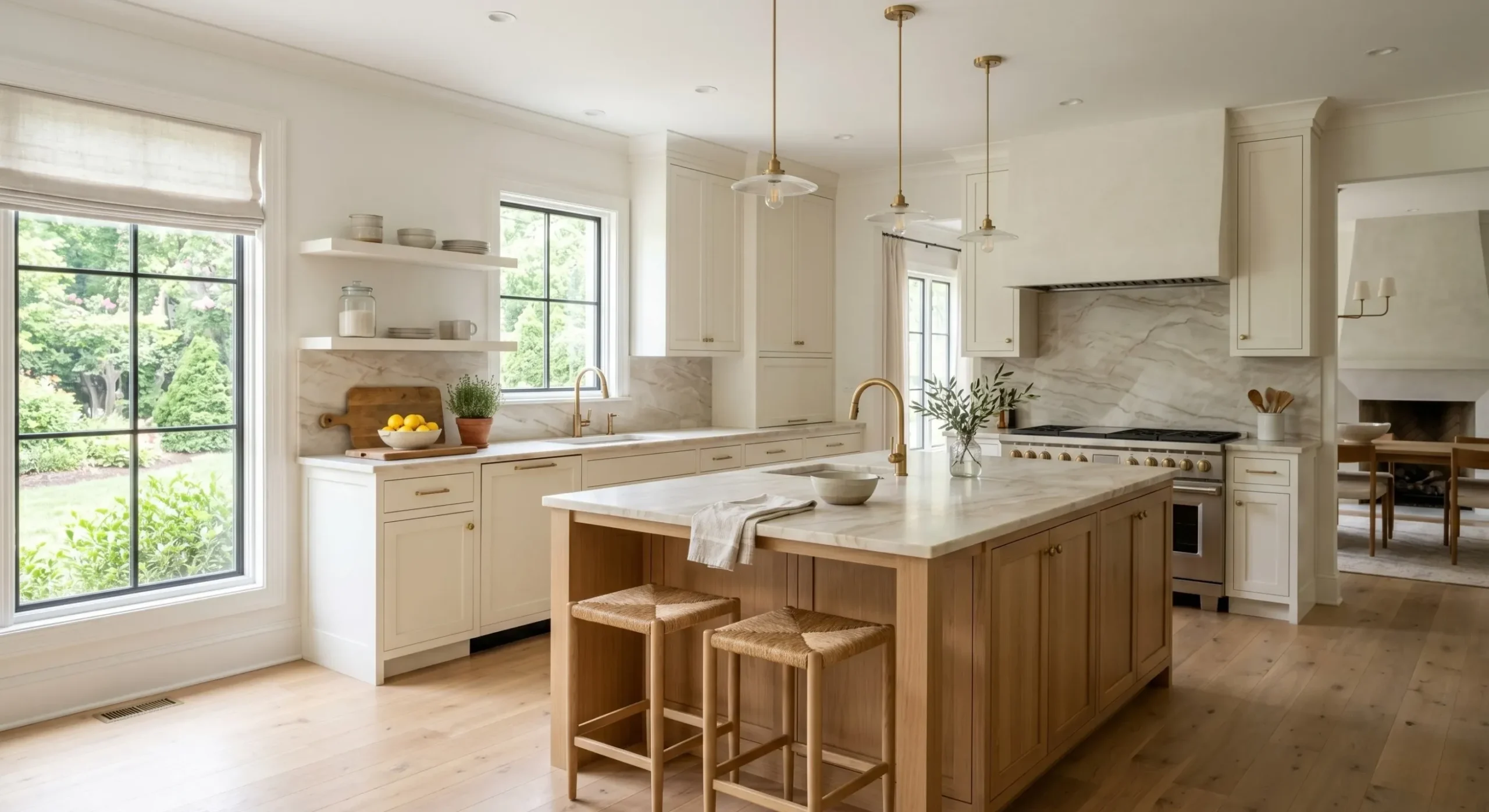
Start With How You Actually Use the Kitchen
Before you compare a single slab, answer four questions honestly. They narrow the field faster than any showroom visit.
How often do you cook, and how hot? Daily high-heat cooking, cast iron straight off the burner, points you toward granite, quartzite, or porcelain, which shrug off heat. Light cooks have the full menu open to them.
Who else uses the kitchen? Kids, frequent guests, and red-wine dinner parties all argue for non-porous, stain-resistant surfaces like quartz or porcelain that forgive a spill left overnight.
How much upkeep will you genuinely do? Be honest. Natural stone wants periodic sealing. Wood wants oiling. If “maintenance” is never going to make your weekend list, engineered surfaces remove the chore entirely.
What’s your timeline in the house? Staying 15 years? Buy the surface you’ll love daily. Selling in three? Neutral, classic materials protect resale, and over-improving past the neighborhood rarely pays back.
Once those answers are clear, the material comparison stops feeling overwhelming. You’re no longer choosing from ten options. You’re choosing from two or three that fit your life.
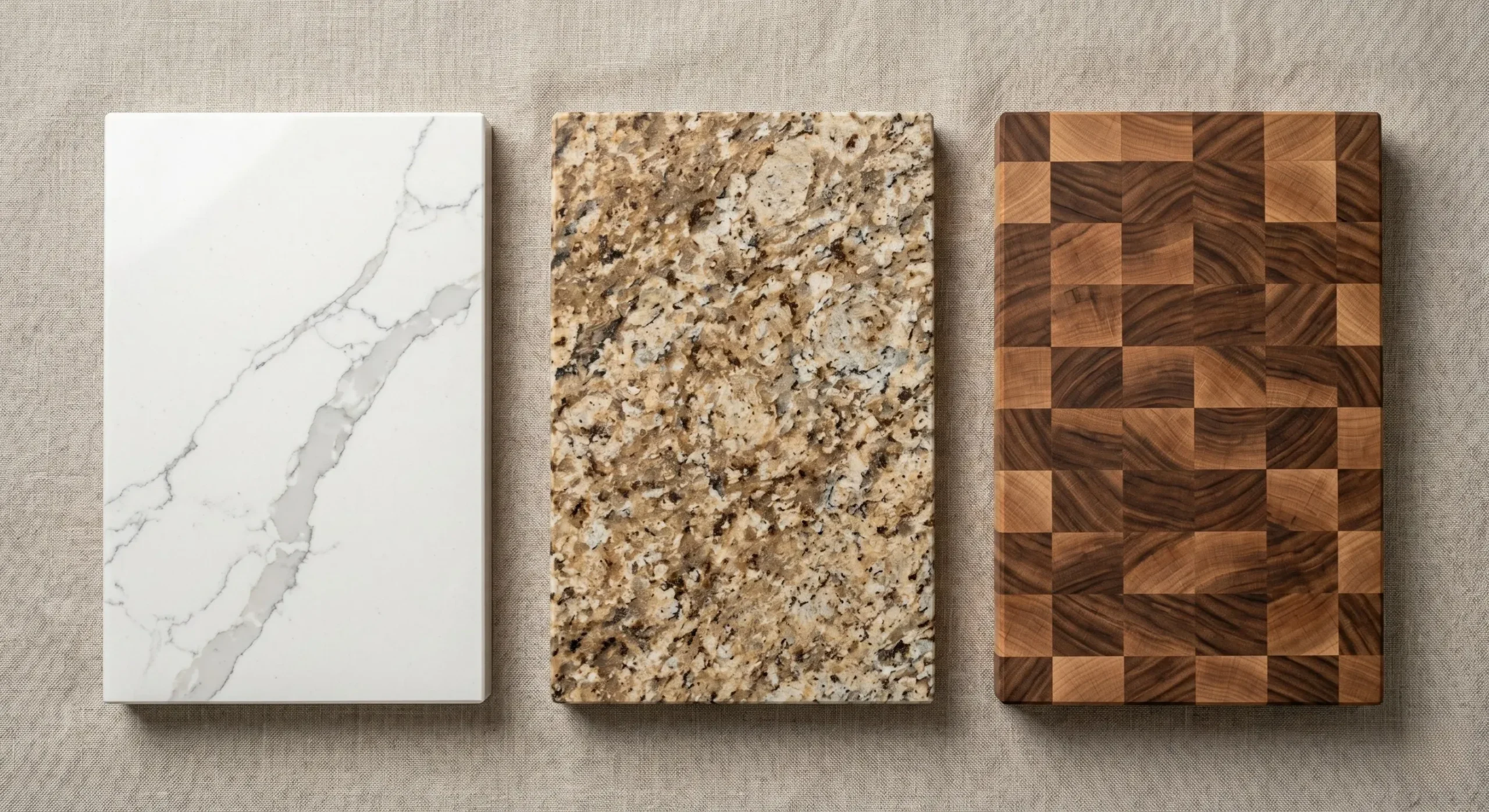
The Countertop Materials Worth Knowing in 2026
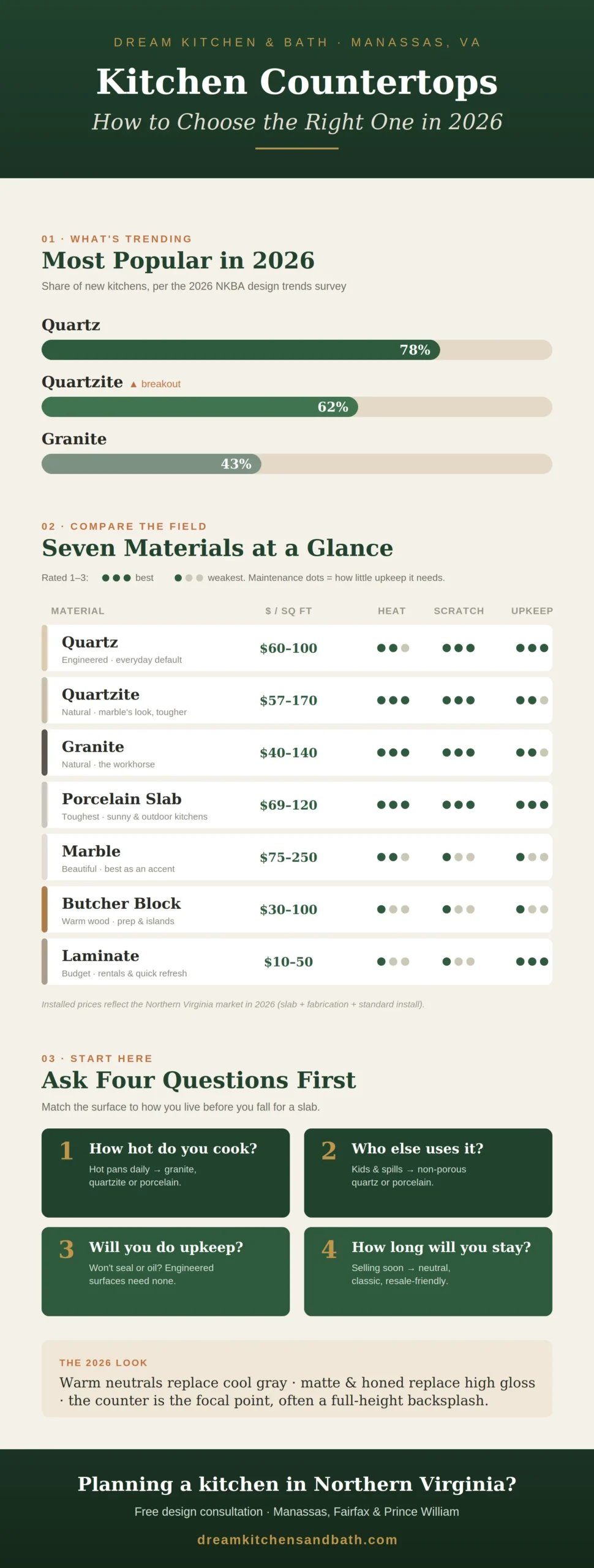
The market has split into engineered surfaces that prioritize zero maintenance and natural stones that prioritize character. The 2026 NKBA Design Trends Report, drawn from a survey of more than 600 design professionals, puts quartz on top at 78%, with natural quartzite the breakout at 62%, while granite has settled to about 43% and marble continues to slip. Here’s how the field looks, with installed pricing reflecting what Northern Virginia homeowners actually pay in 2026.
| Material | Installed $/sq ft (NoVA, 2026) | Heat | Scratch | Sealing | Best for |
|---|---|---|---|---|---|
| Quartz (engineered) | $60–$100 | Good* | High | Never | Family kitchens, resale, low upkeep |
| Quartzite (natural) | $57–$170 | Excellent | Excellent | Periodic | Marble’s look, stone durability |
| Granite (natural) | $40–$140 | Excellent | High | Yearly | Heavy cooks, classic look |
| Porcelain slab | $69–$120 | Excellent | Excellent | Never | Serious cooks, sunny kitchens, outdoor |
| Marble (natural) | $75–$250 | Good | Low | 2x a year | Bakers, low-traffic, island accent |
| Butcher block | $30–$100 | Low | Low** | Oiling | Warmth, prep zones, island accent |
| Laminate | $10–$50 | Low | Low | None | Tight budgets, rentals, quick refresh |
* Quartz takes moderate heat but wants trivets for very hot pans.
** Butcher block scratches but sands clean.
A few others sit on the edges of the NoVA market. Solid surface like Corian runs roughly $35 to $130 a foot and welds into continuous runs with integrated sinks, though it scratches and scorches more easily than stone. Sintered slabs such as Dekton, around $80 to $150 a foot, are close to indestructible against heat and UV but hard to repair if a corner ever chips. Worth knowing they exist; for most kitchens here, the seven materials above cover it.
Quartz: The Default for a Reason
Quartz is ground natural stone bound with resin and pigment, engineered into slabs with consistent color edge to edge. It’s the surface we install most, and the data backs up why: non-porous, so it never needs sealing, highly scratch-resistant, and predictable in a way natural stone can’t be. A quartz counter you pick from a sample looks like the counter that shows up on install day.
The trade-offs are narrow but real. The resin isn’t fully heat-proof, so a pan straight off the burner can scorch or discolor it past about 300°F; keep trivets handy. And in a kitchen with big south-facing windows, prolonged direct sun can yellow some quartz over years, which matters more here than people expect given how many NoVA kitchens open to bright family rooms. The one regret we hear most often, echoed all over remodeling forums, is the look: cheaper veined quartz repeats its pattern across a run and starts to read as printed rather than real. The fix is simple. Step up to a high-quality veined line or pick a quieter solid color, and view the actual slab before you buy. For most households, quartz is the surface that asks the least of you while looking like more than it costs. Brands we carry, including Silestone and Cambria, anchor the mid-to-upper range.
Quartzite: The Stone Having a Moment
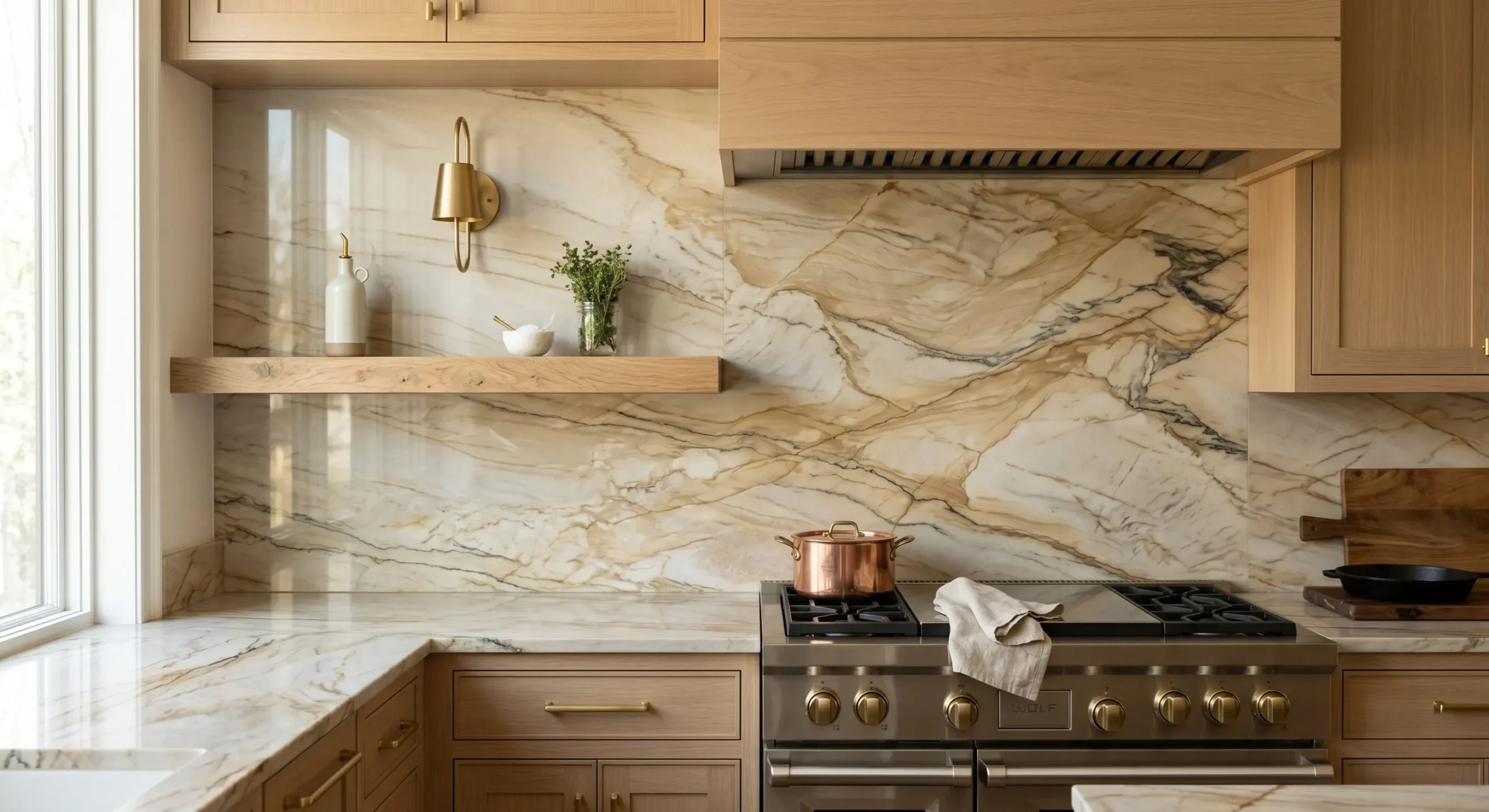
Don’t confuse it with quartz. Quartzite is natural stone, harder than granite, with the flowing veins people love in marble but far more resistant to etching and scratches. It’s the fastest-rising material in our showroom and the NKBA’s breakout pick for 2026, and varieties like Taj Mahal and Fantasy Brown show up on more design boards every season. It’s UV-stable too, so it holds its color in sunny kitchens where quartz can struggle.
The catch is porosity. Quartzite needs periodic sealing to stay stain-proof, and it sits at the higher end of the price range. One more thing to watch: some stones sold as “quartzite” are actually softer dolomitic marble in disguise. Buy from a fabricator who’ll tell you exactly what you’re getting.
Granite: The Workhorse That Earns Its Keep
Granite was the default luxury surface 20 years ago, and while its market share has narrowed, it remains a genuinely practical choice for people who cook hard. You can set a hot pan directly on it. Every slab is geologically one of a kind. It resists chips well and adds dependable resale value.
It is porous, so plan on resealing once a year to keep it stain-resistant, especially around the sink. It’s also heavy, which means your cabinets need to be sound underneath it. For a transitional or traditional Northern Virginia kitchen with serious cooking, granite still makes a strong case.
Porcelain Slab: The Quiet Performer
Large-format porcelain started as exterior cladding and grew into one of the toughest surfaces you can put in a kitchen. It takes heat without trivets, resists scratches and stains, never needs sealing, and stays UV-stable, which makes it the standout for sun-soaked kitchens and the outdoor kitchens we build more of every year. High-definition printing now lets it convincingly mimic marble, concrete, or wood.
Its weakness is the edges. Thin porcelain slabs can chip if the fabricator is inexperienced, so this is not a material to hand to the lowest bidder. Done right, it’s the closest thing to a no-compromise surface on the market.
Marble: Beautiful, and Honest About Its Cost
Marble is still the most beautiful surface most people will ever see, soft veining, a cool top that bakers prize, a glow that makes a room feel larger. It’s also the highest-maintenance stone we sell. It scratches, it stains, and it etches dull spots wherever lemon, wine, or vinegar touch it. Sealing twice a year is the minimum.
Our honest advice: love marble, but use it where it can shine without taking abuse. The pattern in homeowner forums is hard to miss: people who put marble in a busy primary kitchen overwhelmingly report it stains and etches within months, while the people who have no regrets used it on a baking island or a low-traffic perimeter. As the main surface in a kitchen with kids and weeknight chaos, it’ll frustrate you. The look-alikes, marble-pattern quartz and quartzite, exist precisely for people who want the drama without the daily care.
Butcher Block and Laminate: The Honest Budget Picks
Butcher block brings warmth nothing else matches and sands clean when it scars, which is why we mostly spec it as an island or prep accent next to a tougher main surface. It needs oiling and hates standing water near a sink, so treat it like fine furniture, not an indestructible work surface.
Laminate has come a long way from the plasticky sheets of the past. Today’s high-pressure laminates mimic stone and wood convincingly and clean up with soap and water. It won’t take heat or sharp knives, and it carries the lowest resale value of any surface, but for a rental, a quick refresh, or a tight budget with plans to upgrade later, it does an honest job for the money.
Durability and Daily Life
Here’s the practical hierarchy, separate from looks. For pure toughness against scratches and heat, porcelain and quartzite lead, with granite close behind. Quartz wins on stain defense and zero maintenance but wants protection from direct high heat. Marble, butcher block, and laminate sit softer and ask for more care or accept more wear.
Sealing is the dividing line people underestimate. Quartz and porcelain never need it. Granite wants it yearly, quartzite periodically, marble twice a year. Skip the sealing on a porous stone and the first olive-oil spill near the cooktop becomes a permanent shadow. If a sealing schedule sounds like one more thing you’ll forget, that preference alone narrows you to engineered surfaces, and there’s no shame in choosing the counter that takes care of itself.
Color and Style: Designing the Surface
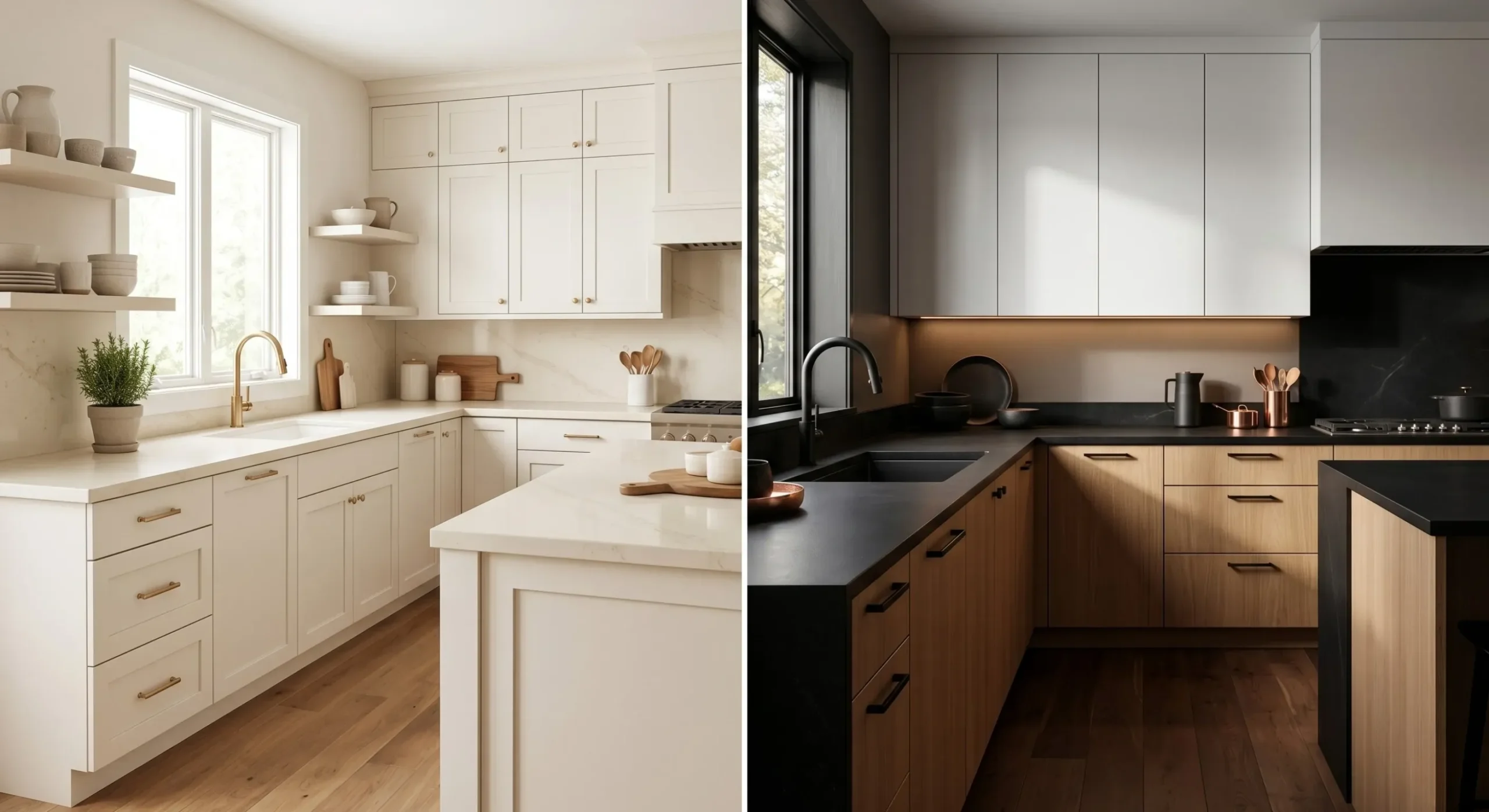
The big 2026 shift is away from cold, sterile white toward warmth. Mushroom, taupe, sandy beige, and “greige” tones lead, and matte and honed finishes are pushing past high-gloss polish because they hide fingerprints and feel grounded rather than clinical.
White kitchen countertops still anchor more remodels than any other choice, but the white people want now reads soft and creamy rather than icy, often with a faint warm vein. Black kitchen countertops, honed rather than polished, deliver drama and pair beautifully with white or wood cabinets for contrast. Blue kitchen countertops and deeper statement tones, forest green, charcoal, muted burgundy, are showing up most often on islands, where one bold surface plays against quieter perimeter counters.
A handful of pairing rules keep kitchen countertops designs cohesive rather than busy. Match undertones: warm cabinets like oak and walnut want warm-veined stone, cool white or gray cabinets want cooler tops. Balance the visual noise: detailed Shaker doors read best with a quieter counter, while flat-slab doors can carry dramatic veining. And always test samples under your own kitchen’s lighting, because a slab that glows in a showroom can fall flat under the LEDs over your island. If you’re still choosing cabinets, our guide to picking the right kitchen cabinets walks through how door style and color steer the countertop decision.
Full-height slab backsplashes are the other defining move of 2026. Running the counter material up the wall to the cabinets removes grout lines and turns a dramatic vein into a continuous panel. The NKBA has quartzite leading both countertops and full-height backsplashes this year, which tells you where the high end is heading.
What Kitchen Countertops Cost in Northern Virginia (2026)
Pricing here tracks a little above the national average because of local labor and fabrication rates. As of 2026, installed costs in the Northern Virginia market run roughly as follows, including the slab, fabrication, and standard installation:
- Laminate: $10 to $50 per square foot
- Butcher block: $30 to $100 per square foot
- Granite: $40 to $140 per square foot
- Quartz: $60 to $100 per square foot for standard to mid-range, with most local projects landing between $74 and $103
- Porcelain slab: $69 to $120 per square foot
- Quartzite: $57 to $170 per square foot
- Marble: $75 to $250 per square foot, with premium grades like Calacatta reaching higher
For a typical 50-square-foot kitchen, that puts a quartz project in the rough range of $3,000 to $5,000, with natural stone and porcelain climbing from there based on slab and edge choices. Two costs people forget to budget: edge profiles and extras. A simple eased edge is baseline, but waterfall ends, mitered thick edges, and ornate ogee profiles add labor and material. Sink cutouts, tear-out and disposal of the old counter, and plumbing reconnection all add line items too.
The biggest sticker shock we see isn’t the slab, it’s the fabrication. Homeowners regularly report quotes where the stone itself was a few thousand dollars but the fabrication and install ran far higher, sometimes more than double the material, and they were stunned because no one walked them through it upfront. Two things protect you. First, ask for the quote broken into material, fabrication, and install so nothing hides. Second, know that edge profile is a real lever: dropping a thick mitered edge for a standard one can cut a fabrication bill roughly in half. Big-box stores add another markup layer on top of the fabricator they subcontract to, which is why those quotes often come in highest of all.
These are countertop-only figures. If you’re scoping the full project, our Northern Virginia kitchen remodeling cost guide breaks down where counters fit against cabinets, appliances, and labor for the whole room.
Installation: DIY or Hire a Pro
Be realistic about which materials are DIY-friendly. Laminate and butcher block are genuinely within reach for a confident homeowner with the right tools. Stone is a different matter. A quartz, quartzite, granite, or marble slab can weigh several hundred pounds, demands precise template work, and needs wet cutting and seam-setting that go wrong fast without experience. A cracked slab on the install costs far more than the labor you tried to save.
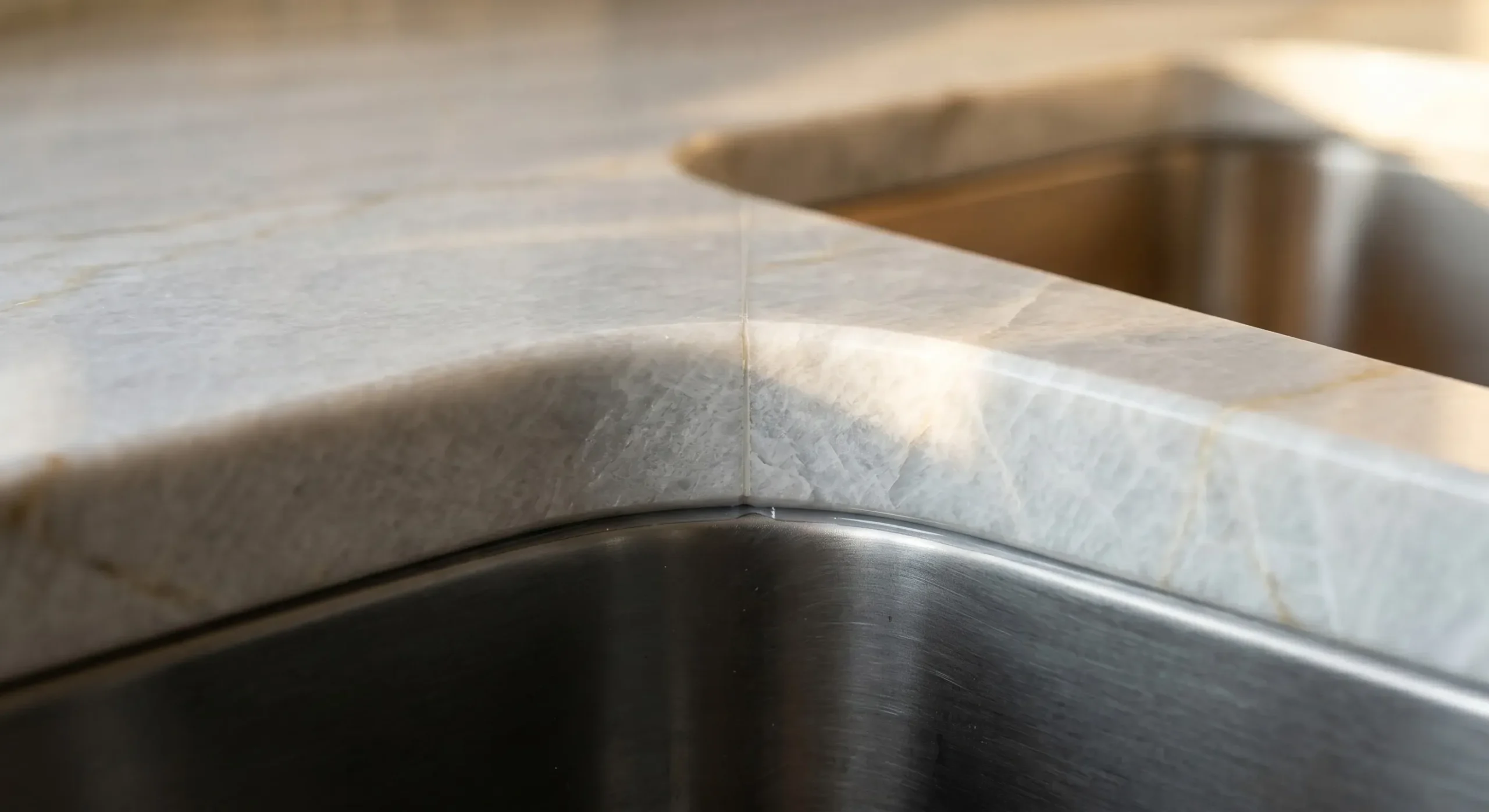
The other reason to use a fabricator is the part you can’t see: level seams, properly shimmed support, and reinforced strips around the sink cutout where thin stone is most likely to fail. That’s where a cheap install reveals itself a year later. Ask any group of homeowners about countertop regrets and the same one surfaces again and again: a beautiful slab undercut by a clumsy, visible seam. The material gets the blame, but the installer is almost always the cause. A good fabricator places seams where they’re least visible and sets them nearly invisible; a rushed one drops a seam across the most-seen run of the counter. From template to finished install, most countertop projects in our area wrap in two to three weeks, with the install day itself running a few hours. If you’re weighing whether to bring in a pro for your project, our team in Manassas handles design through installation under one roof.
The Mistakes That Cost the Most
A few errors come up again and again, and every one of them is avoidable.
Choosing the slab before the layout. Material follows function. Lock in how you cook and how the kitchen flows, then pick the surface that serves it.
Judging a stone from a 4-inch sample. Veining distributes unpredictably across a full slab. Always view the actual slab you’re buying, not a chip, especially for dramatic natural stone.
Under-budgeting fabrication. The headline price-per-foot isn’t the whole story. Edges, cutouts, and disposal can add meaningfully, so get the all-in number in writing.
Skipping the sealing reality check. People buy porous stone, promise themselves they’ll seal it, and don’t. If that’s you, buy quartz or porcelain and skip the guilt.
Over-improving for the block. In homes under roughly $400K, the most exotic marble or quartzite often won’t return its full cost at resale. Match the surface to the home’s tier.
Getting one quote. Material and install pricing varies widely between fabricators. Three quotes protects you and surfaces who’s actually cutting corners.
Frequently Asked Questions
How much do kitchen countertops cost in Northern Virginia in 2026?
Installed kitchen countertops prices here run from about $10 a square foot for laminate to $250 or more for premium marble. Quartz, the most common choice, typically lands between $74 and $103 per square foot installed locally, which puts a standard 50-square-foot kitchen around $3,000 to $5,000. The average cost of kitchen countertops for any given project depends mostly on the material, the edge profile, and how many cutouts and seams the layout requires.
What is the most durable kitchen countertop material?
For combined resistance to heat, scratches, and stains, porcelain slab and quartzite lead, with granite close behind. Quartz is the most stain-proof and lowest-maintenance of all, though it needs trivets for very hot pans. If you cook hard and want to set a pan down anywhere, natural stone or porcelain is the safer bet.
Do kitchen countertops need to be sealed?
It depends on the material. Quartz and porcelain never need sealing. Granite wants it about once a year, quartzite periodically, and marble roughly twice a year. Sealing is quick, but if you know you won’t keep up with it, choose a non-porous engineered surface instead of a porous natural stone.
Can I install kitchen countertops myself?
Laminate and butcher block are realistic DIY projects. Stone is not. Slabs are heavy, fragile until set, and require precise templating and seam work. Most kitchen countertops installation guides that walk through stone are written for trained fabricators, and a cracked slab erases any savings. For natural stone, quartz, or porcelain, hire a pro. DIY kitchen countertops installation makes the most sense on laminate or a wood island.
Which countertop adds the most resale value?
Quartz and quartzite hold their value best, because buyers recognize them as durable and current. Neutral, classic surfaces age better against changing décor than trendy colors. Just don’t over-improve past your neighborhood; the most expensive stone won’t return its cost in a modest-priced home.
What’s the difference between quartz and quartzite?
Quartz is engineered, ground stone bound with resin, non-porous and maintenance-free. Quartzite is natural stone, harder than granite, with marble-like veining but better durability, and it needs periodic sealing. They sound alike and look similar, but they behave differently in the kitchen. We compare two of the most-asked-about stones head to head in our quartz vs granite countertops guide.
Kitchen Countertop Trends and Design Questions
What is the most popular countertop for 2026?
Quartz is the most popular countertop heading into 2026, specified in about 78% of kitchens according to the NKBA’s design trends report. Its appeal is practical: it never needs sealing, resists stains, and comes in consistent patterns. The fastest-rising material is natural quartzite, now in roughly 62% of projects, as homeowners chase marble’s look with far better durability. For most Northern Virginia kitchens we design, the choice comes down to those two.
What countertop colors are considered outdated?
The cool grays and stark, icy whites that defined kitchens through the 2010s are the ones reading as dated now. The shift for 2026 is toward warmth: creams, taupes, mushroom, sandy beige, and soft “greige” tones. High-gloss polished finishes are also fading in favor of matte and honed surfaces. That said, a color you love is never truly “out,” and timeless neutrals age more slowly than any trend. If resale is on your mind, lean warm-neutral rather than cool-gray.
Should a countertop be lighter or darker than the floor?
There’s no fixed rule, and the right answer depends on your kitchen’s size and light. The most common combination in contemporary kitchens is a lighter countertop against a darker floor, which creates contrast and a clear focal point, and works well in larger or well-lit rooms. Flipping it, a darker counter over a lighter floor, feels cozier and suits smaller spaces. The one thing every designer agrees on: don’t match them exactly, and test floor, counter, and cabinet samples together in your actual kitchen before deciding.
What do 2026 kitchens look like?
The 2026 kitchen trades the cold, all-white minimalism of the past decade for warmth and texture. Expect warm-neutral and earthy color palettes, matte and honed finishes instead of high gloss, and natural materials like wood and stone used together. The countertop is now the focal point rather than a background surface, often with dramatic veining carried up the wall as a full-height slab backsplash. Quartzite, warm-toned quartz, and statement islands in deeper colors define the look.
Is granite out of style in 2026?
No, but its role has changed. Granite’s share of new kitchens has narrowed to about 43%, down from its early-2000s dominance, as quartz and quartzite took the lead. The busy, speckled granites of two decades ago do look dated, but cleaner, more uniform granites remain a strong, practical choice, especially for people who cook hard and want a surface that takes direct heat. It still adds dependable resale value. Granite isn’t out; it’s just no longer the default.
What countertops never go out of style?
Natural stone in classic, restrained patterns is the safest long-term bet: white marble with soft gray veining, clean granite, and marble-look quartzite have stayed desirable for decades. On the engineered side, quartz in a warm white or soft neutral ages slowly because it reads as timeless rather than trendy. The pattern is consistent: neutral colors, subtle veining, and quality materials outlast bold colors and of-the-moment finishes. Choose for longevity and you rarely regret it.
The Bottom Line
Choosing kitchen countertops in 2026 comes down to a clear order. Start with how you use the kitchen, weigh durability and the maintenance you’ll genuinely keep up with, then choose the look that fits both the room and your timeline in the home. Quartz remains the most practical pick for most households. Quartzite is the standout for people who want natural stone that lasts. Porcelain leads for serious cooks and sunny kitchens, and marble rewards bakers who’ll treat it with care.
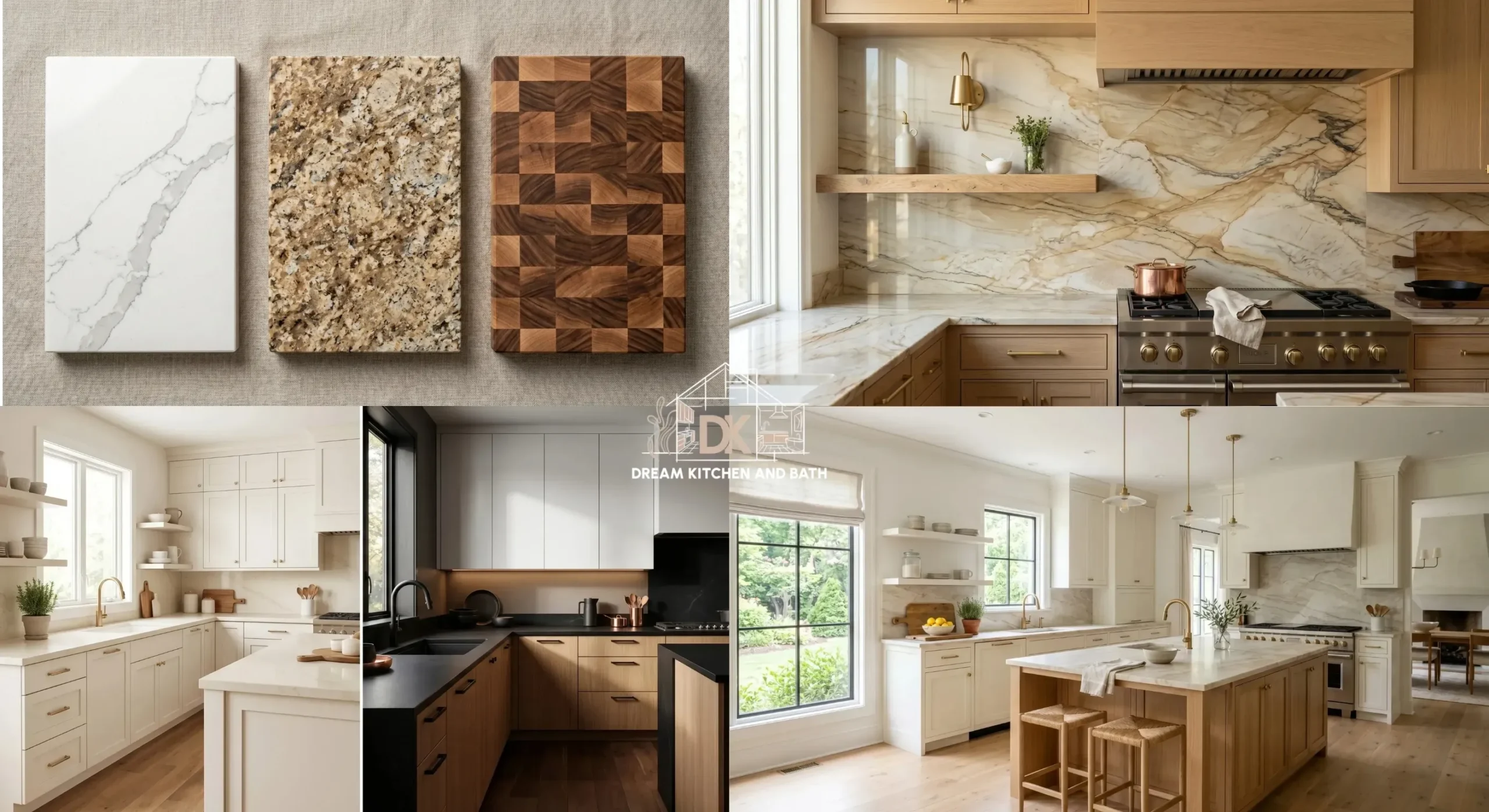
The slab is only as good as the design around it and the hands that install it. If you’re planning a kitchen remodel in Manassas, Fairfax, Prince William, or anywhere across Northern Virginia, you can schedule a complimentary consultation with our design team, browse the countertop options we carry, or see recent kitchens we’ve built to picture how each surface looks in a finished room.