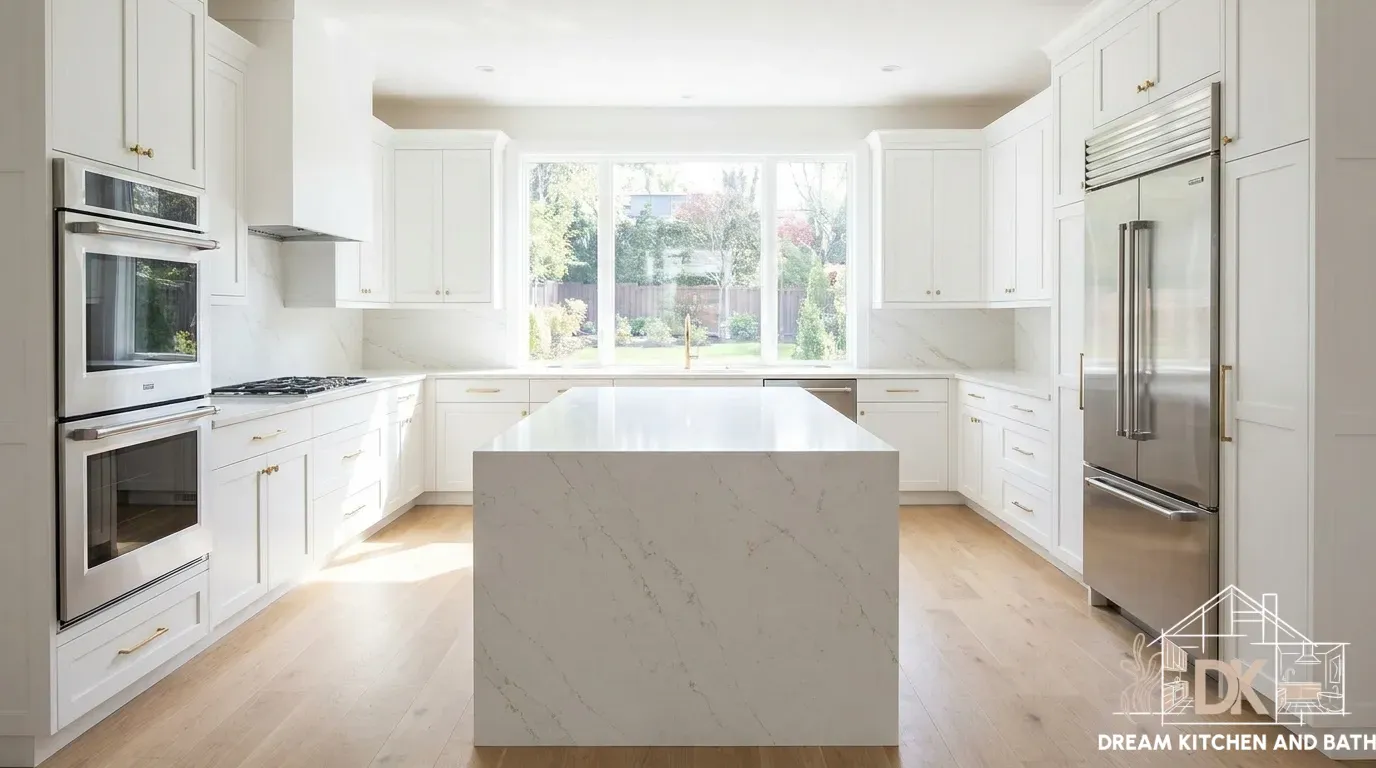
Kitchen Cabinets: How to Choose the Right One in 2026
An average Manassas kitchen has 25 to 30 linear feet of cabinetry. Depending on the cabinet tier you pick, that footprint runs from about $6,000 in stock to $50,000 or more in fully custom. The gap is real, and the cheaper option isn’t always the wrong one. We design and install kitchens across Northern Virginia, and cabinets are the single biggest decision in any remodel. They drive close to 30 percent of the total project budget, dictate the kitchen’s style, and last longer than almost any other element you’ll choose.
This guide walks through the decisions that matter before you sit down with a designer or walk into a showroom: the three cabinet tiers, the materials that actually last, the dimensions for your specific kitchen, current 2026 pricing in the DMV area, and how to match the right cabinets to the right house.
Kitchen Cabinet Types: Stock, Semi-Custom, and Custom
Every kitchen cabinet on the market falls into one of three tiers. The right tier for your project depends on three things: your budget, your timeline, and how flexible your kitchen layout is.
Stock Cabinets
Stock cabinets are pre-manufactured in fixed sizes (widths in 3-inch increments from 9 to 42 inches) and a limited set of finishes. Lead times run 1 to 3 weeks. They’re the cheapest path to a finished kitchen, and the right answer for rental properties, short-term flips, or kitchens where the layout is already standard and you don’t need anything bespoke. The trade-off is flexibility. If your kitchen has a 38-inch wall and the closest stock cabinet is 36 inches, you fill the gap with a filler strip rather than a cabinet sized to your wall.
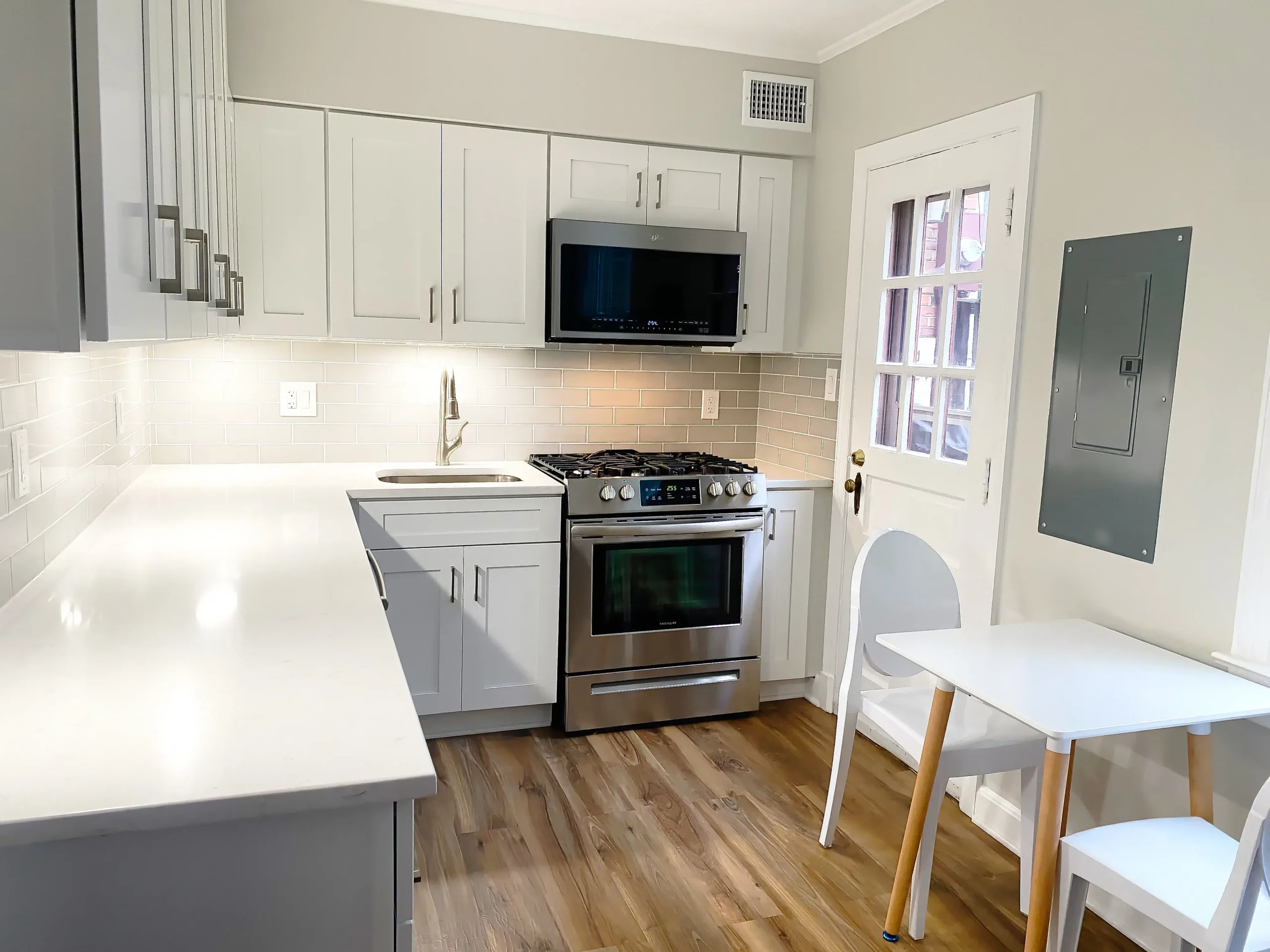
A compact Northern Virginia townhome kitchen we recently remodeled. Stock light-gray Shaker cabinets, white quartz countertops, and a gray subway backsplash — proof that a stock-tier remodel can read just as clean as a semi-custom one when the layout and finishes are right.
Semi-Custom Cabinets
Semi-custom hits the right balance of cost and flexibility for most Northern Virginia remodels. Pre-made cabinet boxes, but with selectable door styles, finishes, interior accessories, and modified sizing. Lead times stretch to 4 to 8 weeks. The boxes themselves are still standardized, but the cabinet you end up with feels designed for your house. The majority of our Manassas-area kitchen projects land in this tier.
Fully Custom Cabinets
Fully custom cabinets are built to your kitchen from the ground up. Any dimension, any wood species, any finish layering, any internal storage system. Lead times typically run 12 to 16 weeks. You pay for that flexibility, often 3 to 4 times what stock costs. Custom makes sense when the kitchen has unusual dimensions, when a specific wood species or door profile matters to you, or when you’re investing in a forever home and want the cabinet boxes to outlast the rest of the kitchen.
RTA (Ready-to-Assemble) Cabinets
RTA cabinets are a flat-pack version of stock. They ship disassembled and you (or your installer) build them on site. The savings come from lower shipping costs and reduced warehouse footprint, not lower-quality components. Some RTA lines use the same plywood boxes and Blum hardware as mid-tier semi-custom brands.
Cabinet Tier
Lead Time
Sizing Flexibility
Cost per Linear Foot (Installed)
Best For
Stock / RTA
1 to 3 weeks
Fixed sizes only
$60 to $200
Rentals, flips, simple layouts
Semi-Custom
4 to 8 weeks
Modified widths, full finish range
$150 to $400
Most NoVA remodels
Fully Custom
12 to 16 weeks
Built to your kitchen
$500 to $1,200+
Forever homes, unusual layouts
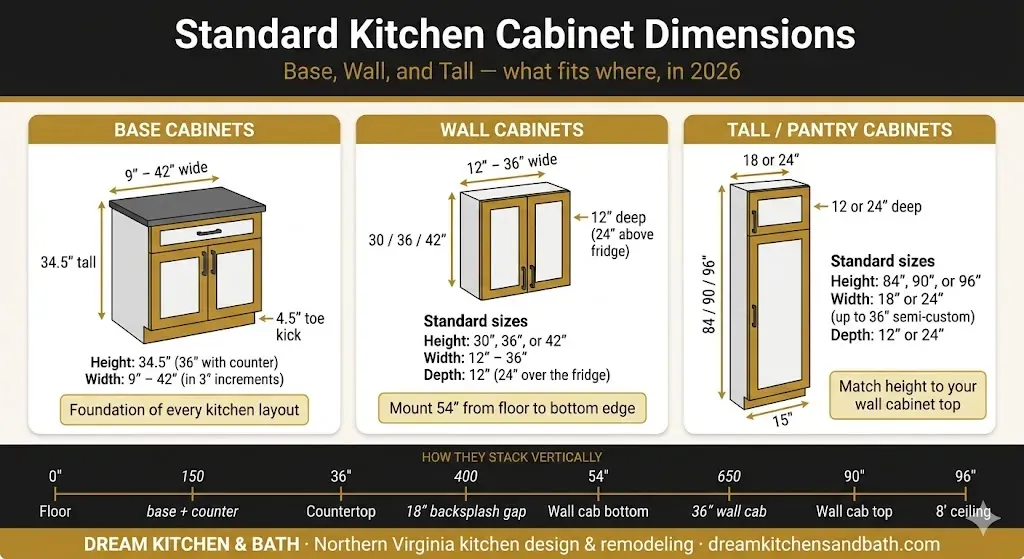
Standard kitchen cabinet dimensions reference: base, wall, and tall (pantry) cabinets, with the vertical relationship between floor, countertop, and 8-foot ceiling.
Cabinets are usually the critical path in a kitchen remodel. When a remodel runs late, it’s most often the cabinets. One r/kitchenremodel poster described a two-month cabinet delay that pushed the entire kitchen offline, with countertop and appliance install both stuck waiting. Treat the quoted lead time as the optimistic case, add 2 to 3 weeks of buffer for damaged-unit replacements, and don’t schedule countertop templating until your cabinets are physically in your garage.
Kitchen Cabinet Materials and Construction
Two cabinets that look identical from across the room can have wildly different lifespans. The difference lives in the box material, the door material, and the hardware. Most homeowners focus on the door, but the box is what fails first when something goes wrong.
Cabinet Box Materials
Plywood is the premium choice for the cabinet box. It holds screws and hinges far better than particleboard, resists water swelling near sinks and dishwashers, and stays straight over decades. Most quality semi-custom and all custom cabinets use plywood boxes.
Particleboard is engineered from compressed wood shavings and resin. It’s lighter and significantly cheaper than plywood, and it’s fine in dry conditions. The problem is that a single dishwasher leak under the sink will swell a particleboard box in days. Stock cabinets and entry-level semi-custom lines use particleboard for the sides and bottoms.
Medium-density fiberboard (MDF) is a denser engineered wood. Its smooth, grain-free surface makes it the preferred substrate for painted doors and panel inserts. MDF holds paint without telegraphing wood grain through the finish. It’s heavy and, like particleboard, vulnerable to water.
If you’re spending real money on a kitchen, specify plywood boxes for any cabinet within five feet of plumbing. Particleboard everywhere else is a reasonable compromise to keep the project on budget.
What can go wrong: the cabinet you specced isn’t always the cabinet that shows up. Cabinet complaints on Reddit follow a depressingly consistent pattern. Homeowners report particleboard sides on cabinets sold as plywood. One r/HomeImprovement poster spent $22K on what turned out to be particle-board boxes and described hinges that fall off and bases that sag under weight. Others describe cabinets arriving warped, scratched, or with blotchy paint, then waiting six weeks for single-door replacements while the rest of the kitchen sits unfinished. Three things to do before you sign the order:
Get the box material in writing on the order. Specify plywood, particleboard, or MDF per cabinet group, not just “premium construction.”
Inspect every cabinet within 24 hours of delivery. Photograph any blemish, warp, or damaged hardware. Most manufacturers tighten replacement policies past 72 hours.
Refuse installation of damaged units. Once a damaged cabinet is mounted, getting it swapped multiplies the labor cost.
Door Materials and Finishes
Solid wood doors come in maple, oak, cherry, walnut, and hickory. Maple is the most common in painted kitchens because its tight grain takes paint cleanly. Oak shows pronounced grain (it’s back in style after a 20-year hiatus). Cherry darkens beautifully with age. Walnut runs the highest cost and reads modern.
Wood veneer over MDF mimics solid wood at a lower price. Done well, you can’t tell the difference. Done cheaply, the veneer chips at the edges within a few years.
Thermofoil is a thin vinyl sheet vacuum-pressed over an MDF core. It’s durable and cheap, but it can delaminate near heat sources like the oven or coffee station. We rarely specify thermofoil for kitchens we expect to last 20 years.
Painted finishes lead the Northern Virginia market in 2026. Most of the kitchens we install ship with painted doors, in warm whites, sage greens, deep navy, or two-tone combinations.
Construction Details That Actually Matter
A few build details separate a 30-year cabinet from a 10-year cabinet:
Frameless versus face-frame construction. Frameless (European) cabinets give you slightly more interior space and a flush modern look. Face-frame (traditional American) cabinets have a wood frame around the front of the box, the look most NoVA homeowners associate with classic kitchens.
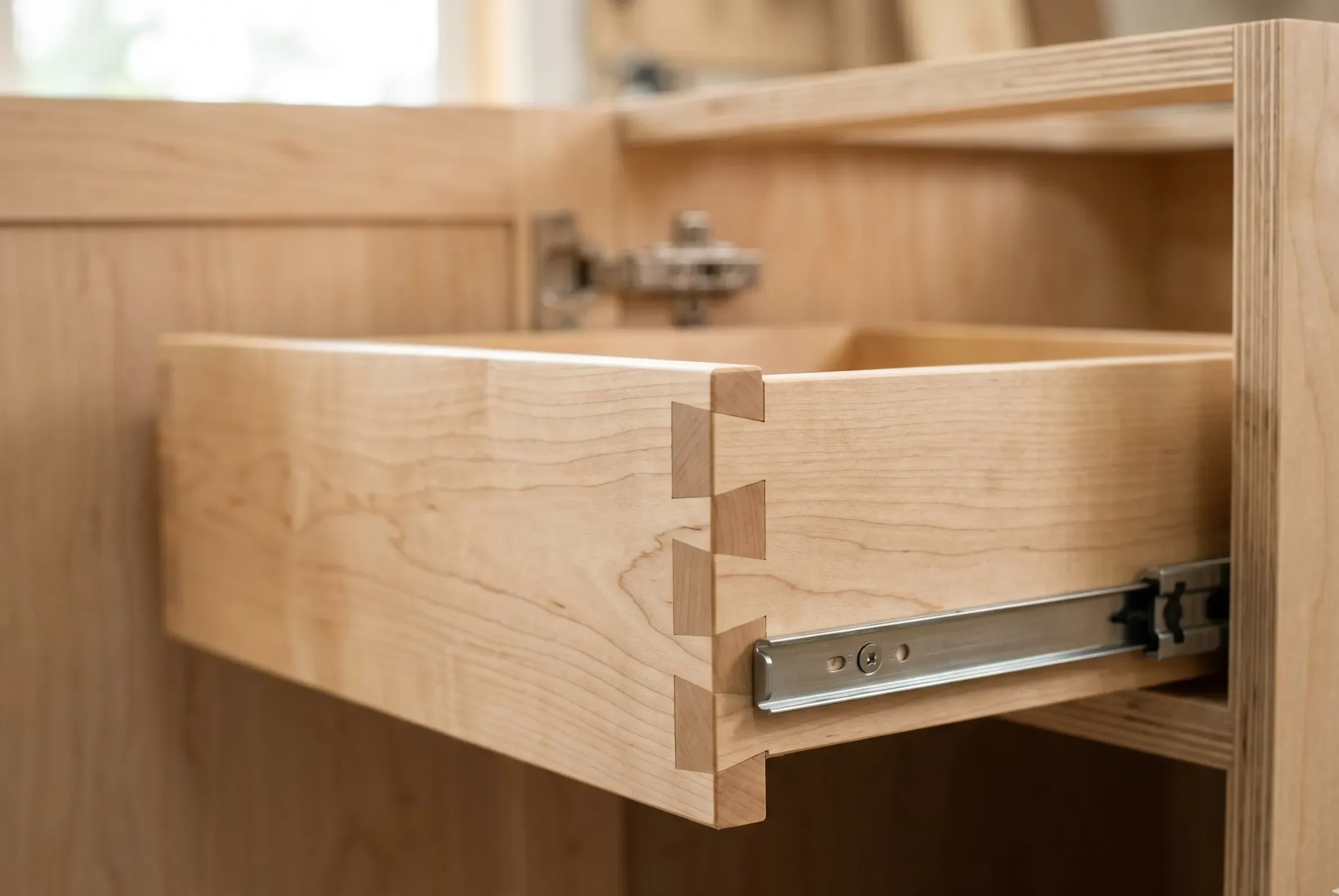
Dovetail drawer joints. A dovetail joint mechanically locks the drawer corners together. Stapled or doweled drawers will eventually fail. Insist on dovetail.
Soft-close hinges and undermount, full-extension drawer slides. These should be standard at the semi-custom tier and above. If a brand is still selling stapled drawers with side-mount glides, walk away.
KCMA certification. The Kitchen Cabinet Manufacturers Association tests cabinets against a published standard (ANSI/KCMA A161.1). The blue KCMA seal means the cabinet has passed structural, finish, and hardware durability tests. Look for it.
Standard Kitchen Cabinet Dimensions
Three cabinet types make up almost every kitchen: base cabinets along the floor, wall cabinets above the counter, and tall cabinets running from floor to ceiling (typically pantries or oven cabinets). Each comes in a standard size profile you should know before laying out the room.
Cabinet Type
Standard Height
Standard Width
Standard Depth
Base cabinets
34.5″ (36″ with countertop)
9″ to 42″ in 3″ increments
24″
Wall cabinets
30″, 36″, or 42″
12″ to 36″ in 3″ increments
12″ (24″ above the fridge)
Tall / pantry cabinets
84″, 90″, or 96″
18″ or 24″ (up to 36″ semi-custom)
12″ or 24″
A few dimensions homeowners often miss: the gap between the countertop and the wall cabinet is typically 18 inches (the standard backsplash height). Wall cabinets hang 54 inches from the floor to their bottom edge. Toe kicks add another 4.5 inches of recessed space under the base cabinets so you can stand close to the counter without bumping your feet. And corner storage almost always means either a Lazy Susan (with bifold doors and rotating shelves) or a blind corner cabinet (which uses the space behind an adjacent run).
Tall cabinet height should match the top edge of your wall cabinets so the kitchen reads horizontal. Pair 84-inch pantries with 30-inch wall cabinets, 90-inch pantries with 36-inch wall cabinets, and 96-inch pantries with 42-inch wall cabinets. If your kitchen has 8-foot ceilings, 36-inch wall cabinets with crown molding is the most flattering combination for most NoVA Colonial and Craftsman homes.
Kitchen Cabinet Cost in 2026: Real Northern Virginia Numbers
Cabinet pricing is usually quoted per linear foot installed, which bundles the cabinet, the hardware, and labor. Prices below reflect what we see across Fairfax, Prince William, Loudoun, and Arlington counties as of 2026, and run roughly 10 to 15 percent above national averages because of higher labor costs in the DMV.
Stock cabinets: $60 to $200 per linear foot installed.
Semi-custom cabinets: $150 to $400 per linear foot installed.
Fully custom cabinets: $500 to $1,200+ per linear foot installed.
For a standard 10×10 kitchen (about 20 linear feet of cabinetry, the industry’s reference unit), expect total cabinet costs of $5,000 to $8,000 in stock, $10,000 to $22,000 in semi-custom, and $25,000 to $45,000+ in fully custom. A 25-linear-foot kitchen scales those numbers up by roughly 25 percent.
The most common refrain on second-opinion consultations: the bill wasn’t the quote. Browse any kitchen-remodel forum and one theme repeats: the kitchen cost twice what the homeowner budgeted. One r/kitchenremodel thread on cabinet pricing put it bluntly. The poster described being gobsmacked by prices for everything, with their kitchen coming in at twice their budget. Another reported a $30,000 spread between the high and low contractor bids on the same scope. The gap is rarely fraud. It’s almost always upgrades and add-ons that weren’t clearly itemized in the original quote. Ask up front whether the price you’re seeing is fully loaded, and what specifically would push it higher.
The line items that quietly inflate cabinet quotes (and that you should ask about up front) include glass door inserts, lighted display cabinets, soft-close upgrades on stock lines, crown molding and light rail trim, decorative end panels, interior pull-out systems and roll-out trays, and a paint-grade upcharge on stained brands.
If you’re trying to size up the whole project, our full kitchen remodel cost breakdown walks through how cabinet pricing fits into the broader budget.
Kitchen Cabinet Styles and Ideas Selling in 2026
Door style sets the kitchen’s personality more than any other single choice. A few dominant looks in 2026:
Shaker. A simple five-piece door with a recessed center panel and clean rails. Still the best-selling door style nationally and the safe choice for Colonial and Craftsman houses, which describes most of the Manassas housing stock.
Slab (flat-panel). A single flat face with no detailing. Reads modern, works in townhomes and contemporary new builds.
Inset. The door sits flush inside the cabinet frame instead of overlaying it. The premium look that high-end designers gravitate to. Expect 20 to 30 percent over a comparable overlay door.
Beaded inset. An inset door with a decorative bead detail around the opening. The most traditional option, common in historic Old Town Manassas and Old Town Alexandria projects.
Color preferences have shifted noticeably since 2023. The dominant 2026 palette in the kitchens we install: warm whites (think creamy off-white rather than stark builder white), sage and forest greens, deep navy blue, and natural walnut wood. Two-tone kitchens have been one of the most consistent trends of the past three years, regularly cited in NKBA design surveys and trade publications. White or off-white uppers paired with navy, green, or natural wood lower cabinets is now a default starting point for new builds and full remodels in Northern Virginia.
Hardware is where you can shift a kitchen’s feel for a few hundred dollars. Matte black pulls still lead the market. Brushed brass is climbing fast and pairs beautifully with greens and natural wood. Polished nickel and unlacquered brass are quiet luxury picks for inset and beaded-inset doors.
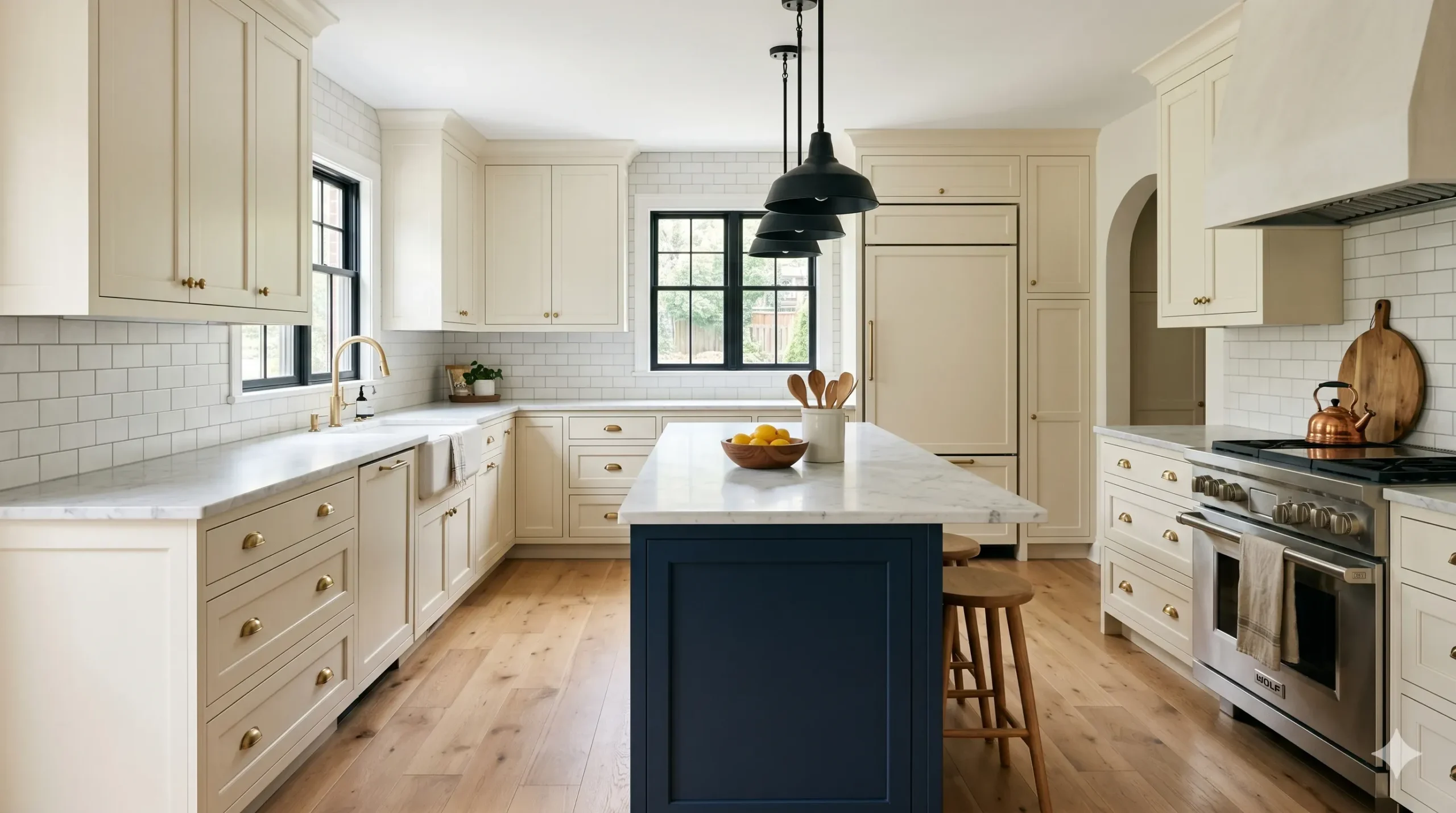
The single biggest cabinet trend of the past three years: warm white Shaker uppers paired with deep navy lower cabinets and matching island. Brushed brass hardware and matte black accents round out the 2026 palette.
Kitchen Cabinet Ideas Worth Stealing in 2026
A few specific kitchen cabinet ideas we’ve seen land well in Northern Virginia projects this year:
An island in a contrasting color. Perimeter cabinets in warm white, island in navy or forest green. Anchors the room without committing to two-tone everywhere.
Open lower shelves on one wall. Skip wall cabinets on a short run and use the wall for art or windows instead. Works especially well in galley kitchens or breakfast nooks.
A large pantry cabinet with pull-out shelves. Two 24-inch tall cabinets with full-extension roll-outs deliver more usable storage than a walk-in pantry of the same square footage, and they free up floor space for a banquette or larger island.
Lower cabinets only over the coffee station. Drop the wall cabinet, add a pendant or sconce, and let the backsplash breathe. A small change that reshapes how the kitchen feels.
Glass uppers flanking the range hood. Two 12-inch wide glass-front wall cabinets break up a long run of solid doors and give you a place to display nice glassware. Add interior LED strip lighting for the full effect.
A vertical tray divider next to the oven. One of the highest-value semi-custom upgrades we install. Costs a few hundred dollars and stops the clatter of cookie sheets stacked on top of each other forever.
For more visual inspiration, browse our recent Northern Virginia kitchen projects. Touching real samples and seeing finishes in context beats catalog browsing every time.
Match the cabinet tier to your total remodel budget. If cabinets will be less than 25 percent of the total spend, stock is fine. Between 25 and 40 percent, go semi-custom. Above 40 percent, custom starts to make sense.
Match the door style to the house architecture. A 1920s Craftsman bungalow in Old Town Manassas wants Shaker or beaded inset. A 2018 townhome in Loudoun County can wear slab fronts well. Forcing a modern slab onto a traditional Colonial almost always looks out of place.
Spend on what you touch daily. Drawer slides, hinges, interior organization. These are the parts of the cabinet you interact with every morning. Cheap glides feel cheap on day one and fail by year five. Skimp on crown molding before you skimp on hardware.
Think about how long you’ll be in the house. Selling in three years? Stock or low-end semi-custom is fine. Staying 15+ years? Pay for plywood boxes and dovetail drawers. The math works out in your favor.
Visit a showroom before you commit. Catalog photos lie about color. Door samples lie about feel. Open the drawers. Close them. Run your hand across the finish. The right cabinet feels right.
One more consideration: if your existing cabinets are structurally sound but cosmetically dated, cabinet refacing (replacing the doors and drawer fronts while keeping the boxes) can save 30 to 50 percent versus a full replacement. It’s a real option for kitchens where the layout already works.
Northern Virginia Layout Quirks Worth Planning Around
Most NoVA kitchens we work in fall into two house types: pre-1960 Colonials and Craftsman bungalows with 8-foot ceilings and narrow original kitchens, or post-1990 townhomes and Colonials with 9-foot ceilings and more open layouts. Each comes with cabinet-sizing pitfalls homeowners often only discover after install.
A few regrets that show up repeatedly in remodel forums and that we work to plan around:
Upper cabinets mounted too low. A common r/HomeImprovement regret is wishing the wall cabinets had been mounted two inches higher. In Colonial kitchens with 8-foot ceilings, the temptation is to drop the wall cabinet line so 42-inch tall cabinets reach the ceiling. The trade-off is a cramped 16-inch backsplash gap. Going with 36-inch wall cabinets and a stacked crown molding usually reads better and feels less closed-in.
Four corner cabinets in the layout. A homeowner on r/kitchenremodel described inheriting a kitchen with corners in every direction (top and bottom, all four walls) and hating the dead storage that came with them. In NoVA Colonials with original galley layouts, blind-corner cabinets stack up fast. Aim for one corner solution maximum, and use a Lazy Susan or a magic-corner pull-out, not a blind cabinet.
Stretching the layout without checking reach. An r/kitchenremodel poster widened their kitchen and then couldn’t reach the disposal switch when the dishwasher was open. When the kitchen gets bigger, the appliance and switch placement has to be rechecked, not assumed.
Ordering the wrong cabinet width. Multiple Reddit threads describe shoddy install where cabinets arrived in sizes that didn’t match the kitchen, a problem that traces back to measurements taken before drywall and trim, then never re-checked. Field-measure after demo, not before.
Frequently Asked Questions
How much do kitchen cabinets cost in Northern Virginia?
In Northern Virginia as of 2026, stock cabinets average $60 to $200 per linear foot installed, semi-custom runs $150 to $400, and fully custom starts around $500 and climbs past $1,200 for premium lines. A standard 10×10 kitchen layout typically totals $5,000 to $45,000 for cabinets alone, before counters, appliances, or labor for the rest of the remodel.
What’s the difference between stock, semi-custom, and custom kitchen cabinets?
Stock cabinets come in pre-set sizes and finishes, deliver in 1 to 3 weeks, and cost the least. Semi-custom uses pre-made boxes with selectable door styles and finishes, takes 4 to 8 weeks, and lands in the middle on price. Fully custom cabinets are built specifically for your kitchen, take 12 to 16 weeks, and cost 3 to 4 times what stock does.
What are the best kitchen cabinets for the money?
Semi-custom cabinets with plywood boxes and solid-wood Shaker doors are the best balance of price, longevity, and design flexibility for most Northern Virginia kitchens. They cost 30 to 50 percent less than fully custom, last 20+ years, and come in enough finishes to suit almost any kitchen design. Look for KCMA certification on the brand you’re considering.
Are cheap kitchen cabinets worth buying?
For rental properties, short-term flips, or kitchens you plan to replace within 10 years, stock or RTA cabinets can make financial sense. For a kitchen you’ll live in for 15 or more years, the long-term cost of replacing failing particleboard boxes usually outweighs the upfront savings. Plywood-box semi-custom cabinets are a better long-term value in most cases.
What are standard kitchen cabinet dimensions?
Base cabinets measure 34.5 inches tall and 24 inches deep, with widths from 9 to 42 inches in 3-inch increments. Wall cabinets are 12 inches deep (24 inches above the refrigerator) and come in heights of 30, 36, and 42 inches, with widths from 12 to 36 inches. Tall and pantry cabinets are 84, 90, or 96 inches tall, in widths of 18 or 24 inches.
How long do kitchen cabinets last?
Quality plywood-box cabinets last 25 to 50 years. Particleboard boxes typically need replacement at 10 to 15 years, and sooner if a sink leak gets to them. Hardware (hinges and drawer glides) often wears out before the boxes and can be replaced separately, which extends the life of an otherwise good cabinet.
Should I buy kitchen cabinets online or from a local showroom?
Stock and RTA cabinets are reasonable to buy online if you’ve physically seen a sample of the finish. Semi-custom and custom cabinets are best ordered through a local design-build firm or showroom. The design fee usually pays for itself in measurement errors avoided, layout improvements, and warranty support when something goes wrong during installation.
The Bottom Line
Cabinets are the single decision that drives the biggest share of your remodel budget and the longest-lasting visual choice in the room. Match the tier to your budget, the door style to the architecture, and the construction details (plywood boxes, dovetail drawers, soft-close hardware) to the time you’ll spend in the house. Almost every other kitchen choice can be tweaked or replaced. Cabinets really can’t.
Planning a kitchen remodel in Manassas, Fairfax, Loudoun, or anywhere across the Northern Virginia DMV area? Our design team plans and installs kitchens like the ones in this guide, from stock cabinets to fully custom builds. Schedule a complimentary consultation to walk through your project, your budget, and the cabinet options that fit your house. You can also find an NKBA-certified designer in your area if you’d like to compare approaches.
Found this helpful? Make us your go-to source on Google
If our content has been useful, you can tell Google to show more of it when you search. Click below, then check the box next to Dream Kitchen and Bath on the page that opens. It takes about five seconds.
You'll need to be signed in to your Google account. One click, then tick the box next to our name.